Designing Lore Blocks
An alternative to stat blocks designed for The 1 HP Dragon.

The first lore block I know.
Ever since I read Reach of the Roach God by Zedeck Siew and Munkao, I've been fixated on one thing. For most folks it's the writing, art, and design—Reach of the Roach God is a sumptuous book, one of my favorites on my shelf—but for me, the real prize is on page fifteen. It's a "stat block" and write-up without stats.
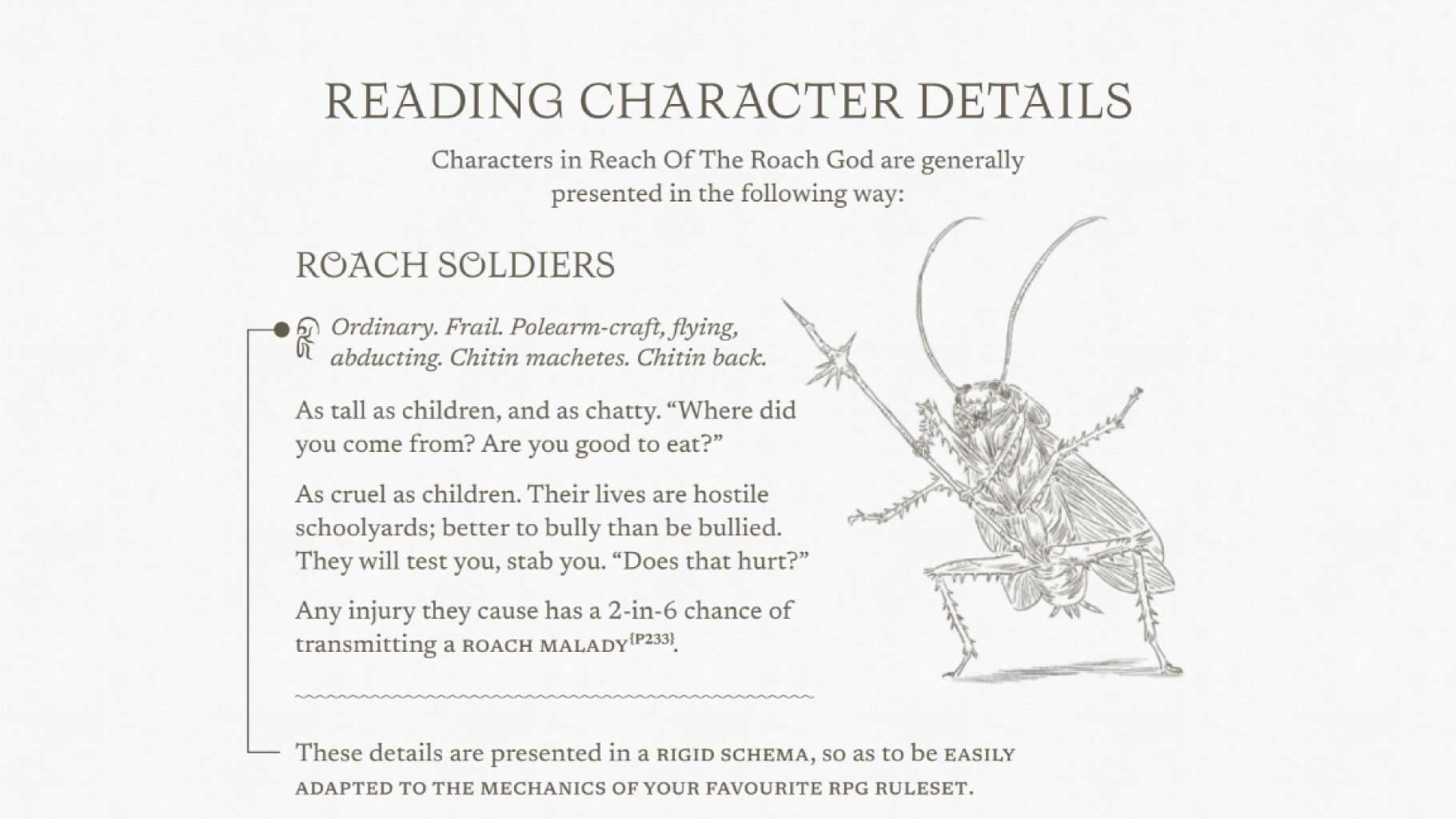
Zedeck describes this creature write-up as a rigid schema. A kind of system-agnostic stat block. Except it doesn't have stats, so it focuses on the other details that give a character substance —things like relationships, actions, and reactions.
Since the book is almost impossible to get now, I'm going to share the magic behind this tidy little passage using Zedeck's own words.
How the rigid schema works.
#1 The FIRST WORD describes the power this character wields in the world:
- ORDINARY. Common folk; a wild boar; a venomous krait. (A kind of snake.)
- EXTRAORDINARY. Storied Heroes; a fearsome ghost; a demon.
- POWERFUL. Saint-kings; a city god; an earthquake giant.
- OVERWHELMING. Sea goddesses; world spirits; ancient divinities.
#2 The SECOND WORD describes the health of this creature:
- HALE. Muscular; vigorous, can take hits.
- FRAIL. Unhealthy; brittle, goes down quick.
#3 The THIRD SENTENCE is a list of three skills this creature is expert at. They should receive significant advantages whenever acting on or challenged in these things.
#4 The FOURTH WORD describes the creature's attack: the weapon or body-part they use to cause harm, or defend themselves. Can they be disarmed? (Remember this for later.)
#5 The FIFTH SENTENCE is a list of the creature's defenses: armor, or protective charms. Every item on the list offers additional protection. Can these shields be broken? (Again, remember this for later.)
Breaking down the rigid schema.
A few things about this schema stick with me. For one, it lends a lot of broad detail that traditional stat blocks might otherwise obfuscate, bury, or offload to tools. I always found it strange how often stat blocks open with a character's more passive features. This schema conveys those same details—general power and health—in relation to other things, which ties them to the world, dungeon, and setting. In a way, attributes do this, but the relationship is murky. For example, in Mausritter, attributes relate to other mice, but have no proportional scale with something like cats or snapping turtles. The same applies to games that have universal stats, like strength and dexterity.
Zedeck's relational "stats" might be inevitable, given the ultimate goal of translating these characters to a system—but I think we actually gain something in the exercise that wasn't there before: orientation within the world via comparison.
The second thing I like about this schema is how economical it is. Broadly, this schema has a lot in common with character write-ups in games like Apocalypse World and Blades in the Dark. But it feels and relates to play very differently by the way it's written and tied to purely diegetic elements. I like how everything after the first and second word are actions and reactions. How it conveys information through natural speech. And I especially love its lossless translation to the fiction. These are words the characters might actually use to describe each other, there's no pidgin language between the players and characters. What's on the page and in the fiction is nearly identical.
After this rigid schema, character write-ups get Zedeck's characteristic stabs of prose. Characters come to life in their own words, signaling their motives, desires, and all the quirky details you might use to actually roleplay them at the table.
What can we take away from this schema?
The schema is an awesome innovation for adventure games disguised as a system-agnostic workaround. It's a shame I haven't seen it adopted in other adventures. It's fun to read, unobtrusive, and shores up the intrinsic qualities of the adventure and setting. What the schema in Reach of the Roach God choses to convey reinforces what the world is about, and creates a web of similarities and differences between characters.
For example, in one village, almost every character is labeled as unprotected. They have nothing shielding them from harm. It's so ubiquitous, you might think they're all defenseless. And then, just when the pattern is set, it breaks. A character gets charmed beads where unprotected should be. Then another character, the oldest and frailest of the bunch, gets a brass amulet. In a more traditional stat block, every character, even unprotected ones, might have some kind of AC, "Armor as Leather," or similar baseline, but in this schema the difference is starker. The beads and amulet mean something—they have to when the economy of words is so slim.
It should also be mentioned that the schema paints directly onto the mind, which means anything that provides additional imagery—like Munkao's illustrations—don't have to clarify or double-up on what's written. It can provide new information. The schema favors action and sensory details that can't be drawn, like sounds and smells. The art gives us visuals, textures, and even personality in the facial expressions.
If I was to adopt this technique in an adventure today, I'd think about the changes I might make to match my genre or themes. If it were a fantasy epic, I might add a third word noting a noble house, like in Game of Thrones. If it were a sci-fi game, I might add another word like organic or synthetic. This schema is flexible enough that it could accommodate a wide range of genres.
But, I can't leave it at that. I have a 1 HP Dragon to slay. A system without hit points, stats, or even combat in the conventional sense, and I think this schema or "lore block" is a big piece of the puzzle.
This next part is about Lore Blocks.
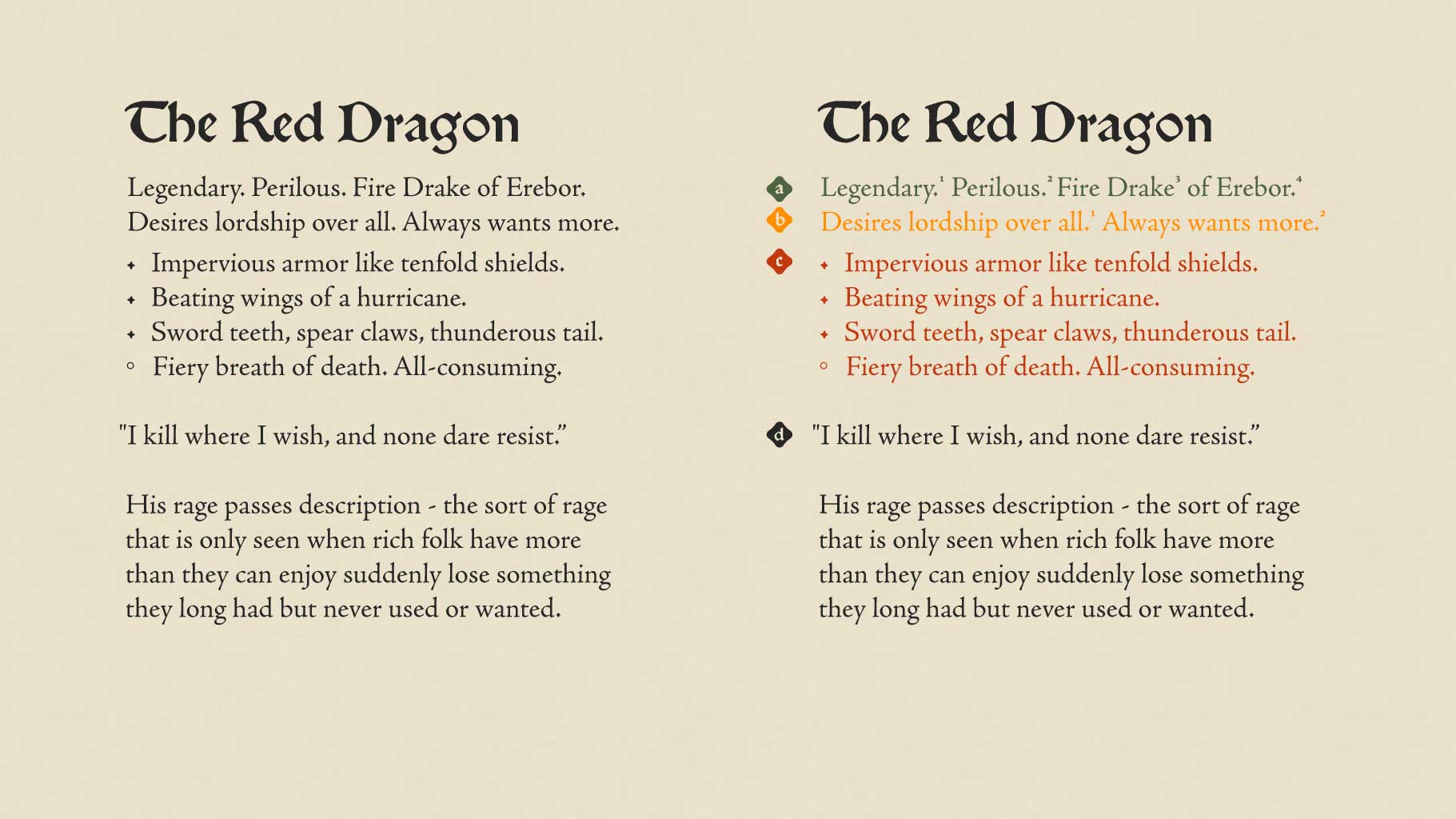
Introducing the lore block.
You can see the similarities. It's the same basic idea made for a game you can't play yet. If you haven't read The 1 HP Dragon, you might not notice the nuances here, but I'll walk us through it.
How the lore block works.
This lore block uses the same basic principles as Zedeck and Munkao's schema, but works with no conversion. In my current playtests, Whisker Kings (A swords-and-whiskers Arthurian epic) and Troubleshoot (A sci-fi problem-solving adventure game) player characters have to "solve" their enemies before they can defeat them. If they can do so with no risk of failure or harm—they don't have to roll. In the next installment of "Slaying the 1 HP Dragon," I'll eventually reveal how that works.
In the meantime, let's look at the pieces that make up lore blocks (look up):
The Opening Line
A1. The FIRST WORD is the influence this creature has on the world. It tells the game master how notable this creature is. How important are they to the larger narrative before the players potentially kill or promote them?
- COMMON. Ordinary folk; a pack of wolves; a bandit.
- UNCOMMON. Notable individuals; zombies; a bugbear.
- STORIED. Power players; a chimera; a famed bard.
- LEGENDARY. Faction leaders; a dragon; a lich.
A2. The SECOND WORD describes the power this creature has to inflict harm. It tells the game master how aggressive to play the creature, and the consequences for player failure. Less powerful creatures can take multiple rounds before they threaten harm, if ever. Powerful creatures put harm immediately on the table.
- HARMLESS. A non-dangerous, trivial, or powerless creature.
- HAZARDOUS. A creature that can create complications. Inflict harm if able.
- DANGEROUS. A creature that creates complications and inflicts harm.
- PERILOUS. A living complication. Harm is inevitable. Death is likely.
A3. The THIRD WORD describes the creature's kin. In fantasy this is their species, but it could just as easily be a political ideology, profession, or nickname. It depends on the game and how it interacts with the fourth word.
A4. The FOURTH WORD describes the creature's affiliation. If they have no faction, their affiliation defaults to the land or ecosystem they live in. Grouped with the earlier influence, power, and kin, this opening salvo communicates the consequences for messing with this creature. Do they have friends? Will they be missed? Will someone or something mourn their defeats and aid their victory?
The Personality Lines
B1. The FIRST SENTENCE is the creature's instinct, goal, or love. A really good line should color the creature's attitude and behavior. It should also give the GM and players something they can bargain or leverage (if they can figure it out).
B2. The SECOND SENTENCE is the creature's weakness, flaw, or hate. These tend to be a lot easier to write, they lend themselves to player interaction and incentive. They also tend to lead into the creature's armors (and how to circumvent them).
The Creature's Armor
C. The creature's armor is where the lore block is its most mechanical. In the fiction, a creature can have an almost infinite number of barriers protecting them. Most of them are common sense, like being in another place, out of reach, or a bear being immune to an onslaught of spoons. But the lore block's armor are narratively-significant. They indicate not only what protects the creature but what they do and how they do it.
- BARRIERS. Many armors are metaphorical walls, like plate armor, invisibility, or an immunity to slashing weapons. They're what keep the creature safe. Player have to find a way to either bypass, negate, or break a barrier.
- DETERRENTS. Sometimes the best defense is a promised stabbing for the trouble. Players have to describe how they avoid, withstand, or break a deterrent if they don't want to suffer it. Can they be disarmed?
- FALLOUTS. A creature with sizable influence will always leave lasting consequences in their absence, but fallout is immediate—it's an explosion, disease, or curse. Exceptionally prepared players solve for fallout.
The Creature Description
D. The last part of the lore block is its most open-ended. Mine usually include a quote, a telling description, and some loot. It's very easy to write when you're cribbing from JRR Tolkien. I did my best to match my inspirations, Zedeck, Gearing, Jonathan Gold, and Richard Stark.
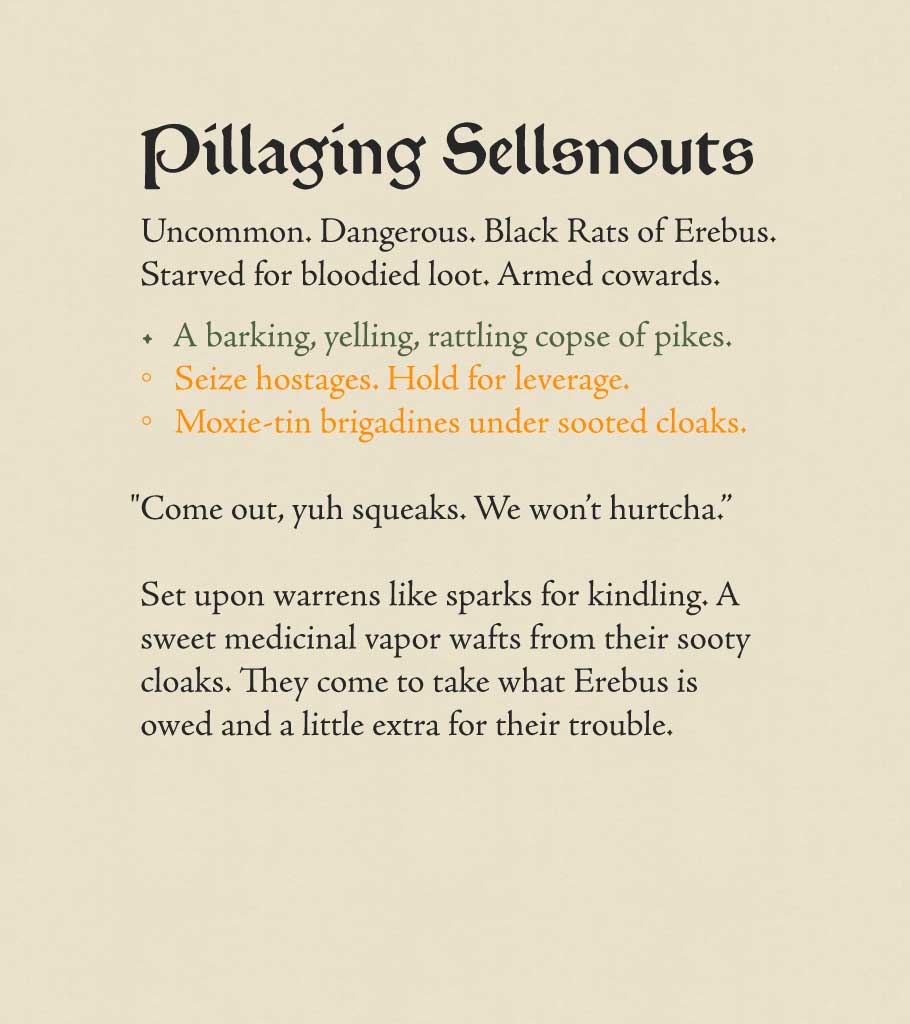
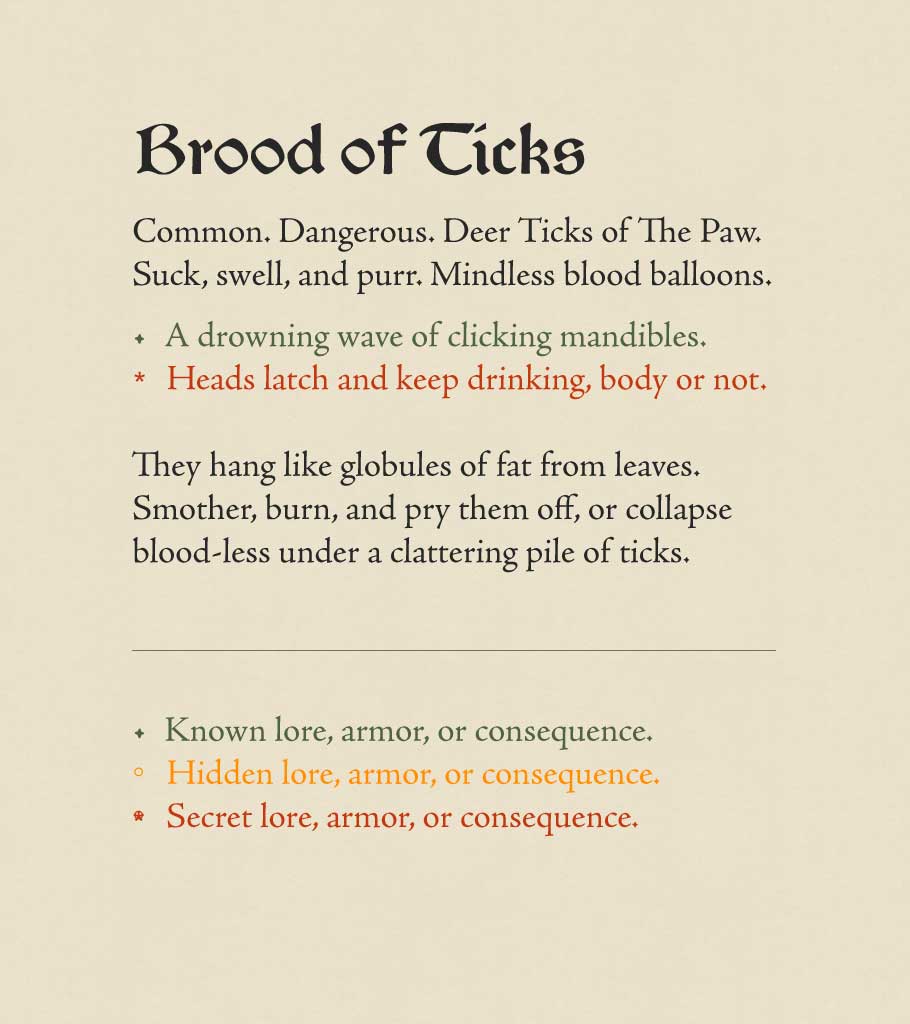
Two lore block examples from a home game called Whisker Kings.
How to design fantasy lore blocks.
Above are two lore blocks from my sword-and-whiskers game of Whisker Kings. The example on the left is an armed gang of bandits serving the Maine Coon Cat, Erebus—the dread queen. The one on the right is a common occurrence in New England made surprisingly horrific when seen from the perspective of a mouse, mole, or frog.
How lore blocks encourage exploration.
You might have noticed different symbols in the list of armors. That's because it uses DIY & Dragon's seminal post: Landmark, Hidden, Secret. Not all armors are immediately obvious to the players, some have to be discovered.
- KNOWN. This is indicated by an ordinary black bullet on the list. A known armor is like a landmark, it's automatic and free. It sticks out. The GM gives it to the players as part of the description. When I'm playing virtually, I type it out. When I'm in person, I tap the table and slide over an index card.
- HIDDEN. This is indicated by a hollow bullet on the list. Hidden information isn't automatic. Players have to ask questions to learn them. Sometimes they even have to pay a cost like time and resources. The sellsnouts, for example, take hostages to even the odds. A deft GM would signal this early and often.
- SECRET. This is indicated by a star on the list. Secret information is the opposite of automatic. It's costly. Player characters have to find the answer in the world through exploration, trial and error, or by finding out the hard way. In the case of the ticks, killing the body doesn't kill the head—just like in real life. The player characters can find this out the hard way, or they can learn it from NPCs, the world, or by baiting the swarm.
How lore blocks handle groups.
Individual creatures might have lore blocks, but as you can see from the above example, I like my groups contained to just one. Their leader might be separated, but for the average foot soldier, pack, or swarm—the group is another armor.
So, how do players handle groups? The same way they handle armor. They can try to split them up, effectively breaking them into multiple smaller lore blocks without the group for armor. They can fight them using superior tactics. Or better yet, they can bide their time, wait for an opening, or negotiate.
Particularly clever (or desperate) players might even come up with a plan to bypass or negate the group's armor. For example, a raving rabble of goblins can be tricked. A group barking orders can be thrown into chaos. And a flood of insects is mindless. They can't adapt to fire, water, or plain old evasion.
Two lore block examples from a home game called Troubleshoot.
How to design sci-fi lore blocks.
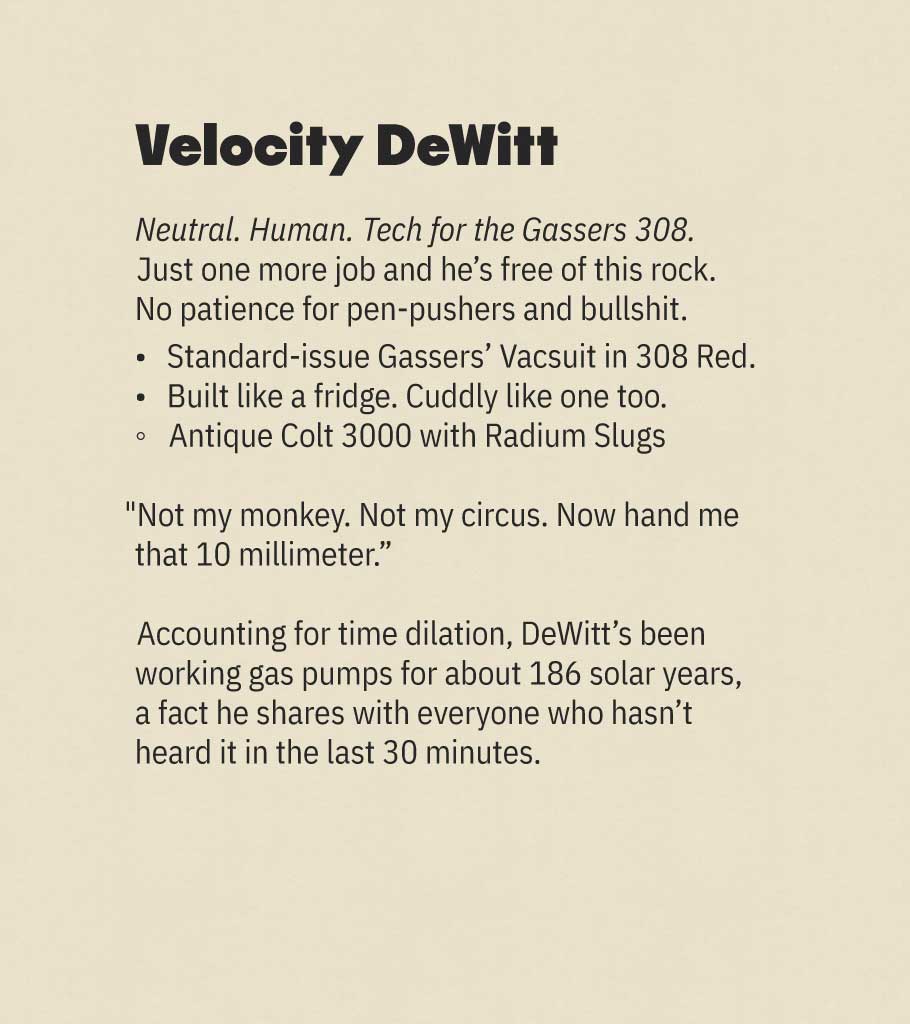
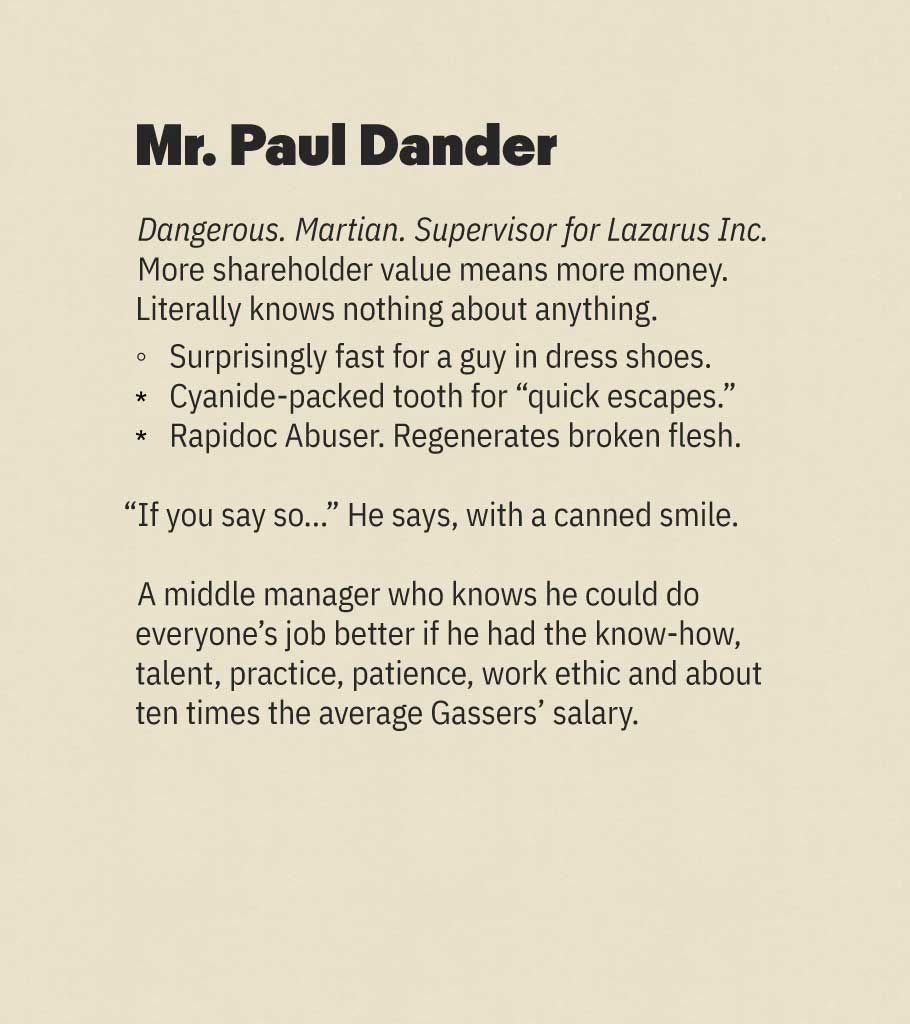
Up until this point, I've shown how lore blocks handle fantasy and un-named creatures. Now, I want to show you how they handle non-player characters in a genre like sci-fi. These two examples come from Troubleshoot, a sci-fi home game about freelancers in a weird galaxy of aliens, corporations, and high-concept problems. Think Star Trek meets Alien. More adventure than horror.
You'll notice some changes in these lore blocks. Starting with the first line which no longer has a level of influence, in space, everyone is rare and consequential, so it's not as important to the setting. We still have our power, species, and faction affiliations, but now the goals and weaknesses are more pronounced with each sentence getting their own line break.
Notice how Mr. Paul Dander has a secret armor that triggers as fallout. Sometimes the fallout is that the creature dies on their own terms. Hopefully, the players check his personal computer before they try to shake him down. He's a company man in more ways than one!
How lore blocks handle items and loot.
In traditional stat blocks, monster features often do double duty when it comes to loot. For example, a goblin with a "hand ax attack," keeps a hand axe in their inventory, even when its not listed. The same efficiency exists in lore blocks.
Monsters, creatures, and characters tend to carry what they use—which is why they often manifest as armor, motives, and weaknesses. Weapons, for example, are always deterrent-like armors in the hands of smart characters. A man with a gun will use it. Similarly, being weighed down by loot can be shown through a weakness. In video games, it's normal to carry around an arsenal. In a normal story, it makes the packmule look like a walking vending machine.
I like this method because it encourages the GM to show loot in action and prove its value (and risks). A key card is boring—or even worse, undefined—when it's stuck in a character's pocket, but if Paul Dander had one, he'd use it to lock doors and trigger airlocks. Immediately raising its value to onlooking troubleshooters.
The other strength of lore blocks are their limitations. They force designers to distribute details elsewhere. Most loot should be in the environment if its not going to be used, abused, or protected by the NPC. In the environment, it tells a story and adds interactive kindling to the scene.
Lore blocks in summary.
If you're thinking about adapting lore blocks for a system-agnostic adventure, I strongly recommend building on the example made in Reach of the Roach God. It's easy to convert, and effective at conveying what really matters in play. Some designers create system-agnostic adventures with facsimile versions of an OSR ruleset, and they always demand a little extra interpretation and translation.
If you're thinking about using the beefier versions, I recommend hacking them into form. The best lore block is going to focus on the elements that matter most to your game.
Ask yourself these questions:
- Does my game care about danger levels, relationships, or factions?
- Is my game powered by npc motives, agendas, and weaknesses?
- How combat-heavy is my game? How diplomacy-based is it?
Finally, if you're going to write lore blocks, I have a few personal rules:
- Use natural language. Avoid coined rules, abilities, and phrases.
- Leave the numbers out of it. Convey things in words when possible.
- Write details that connect. Plant solutions and patterns in the lore block.
- Make your details do double duty as loot, world-building, and tone.
Next time, I'll try to share my home games. That article will be titled "Slaying the Dragon" in the meantime, let me know what you think in the comments and on social. You can find me on Bluesky.
Thanks for reading!
Related articles
 Clayton Notestine
 Clayton Notestine
 Clayton Notestine
Explorers Design is a project by Clayton Notestine. If you liked this article, please consider liking, sharing, and subscribing. Paying members get access to bonus tools and templates as a small thank you.