The Jackian Magic System
Experimental mechanics that combine Mausritter inventory, Tetris, and engine-building into an alternative Vancian magic system.

Jacking the Vancian Magic System
The infamous "fire-and-forget" magic system of D&D comes from Jack Vance novels. In those stories, spells are living entities, thrashing between the ears. When a wizard casts "fireball," it looks like a fiery little warhead. In reality, it's a massive fire elemental getting forced through the pinhole of someone's mind.
Am I misremembering Jack Vance novels? A little bit. (Maybe a lot.) I'm definitely mixing them up with Jonathan Stroud books. Either way, what matters is this: D&D's magic system is just one approach. I'm interested in alternatives.
Imagine this: every wizard's mind is a fortress, built to contain the demons inside their head. As the wizard grows in power, their mind fortress expands, deepens, and evolves to find, trap, and feed its inhabitants. But this power comes at a terrible cost, as wizards grant these spirits foothold, the wizard willingly (or unwillingly) gives them the power to colonize it—and slowly the demons from the humble light to the all-consuming fireball take over the wizard.
Here is my draft of a new Vancian Magic System. The Jackian Magic System.

Do you like discovering the power of design in tabletop roleplaying games? Sign up for Explorers Design and get the next article teleported right to your inbox.
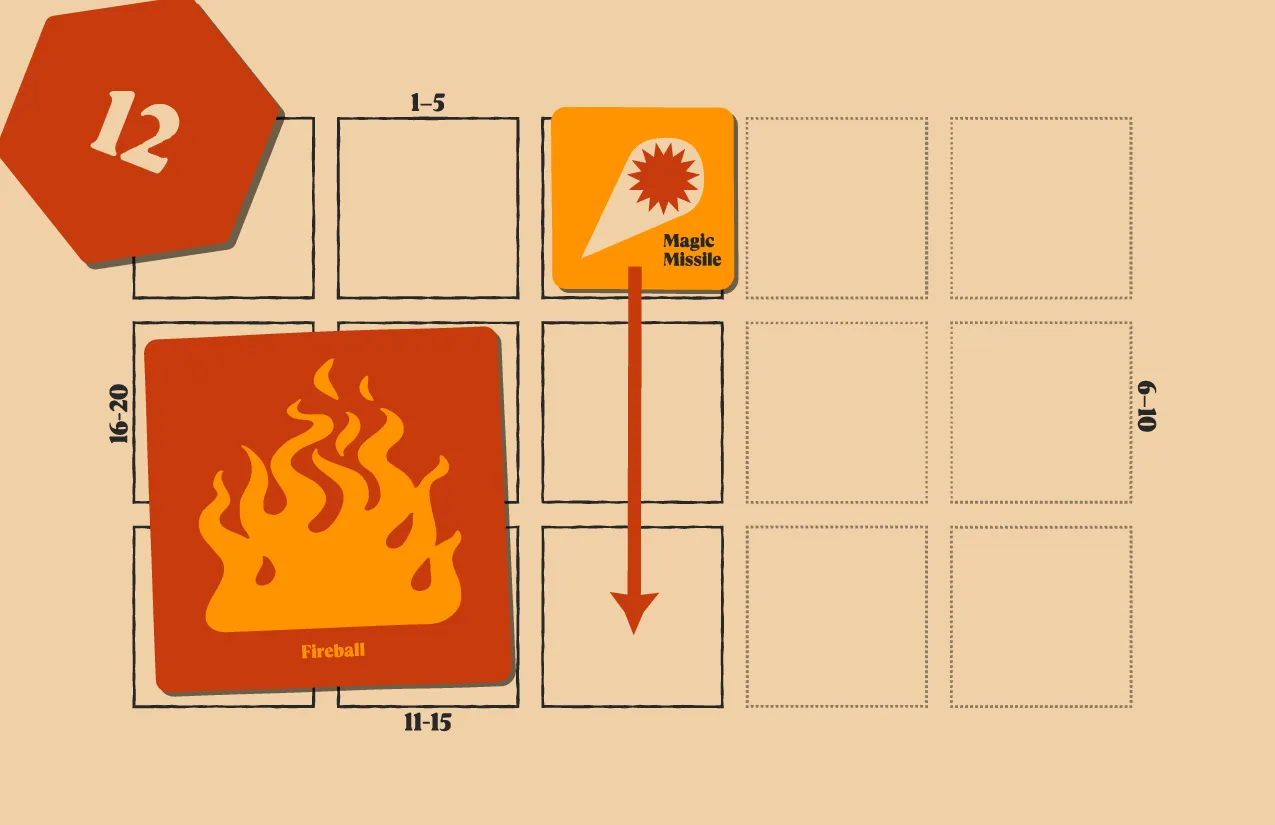
Spellcasting Tetris-style.
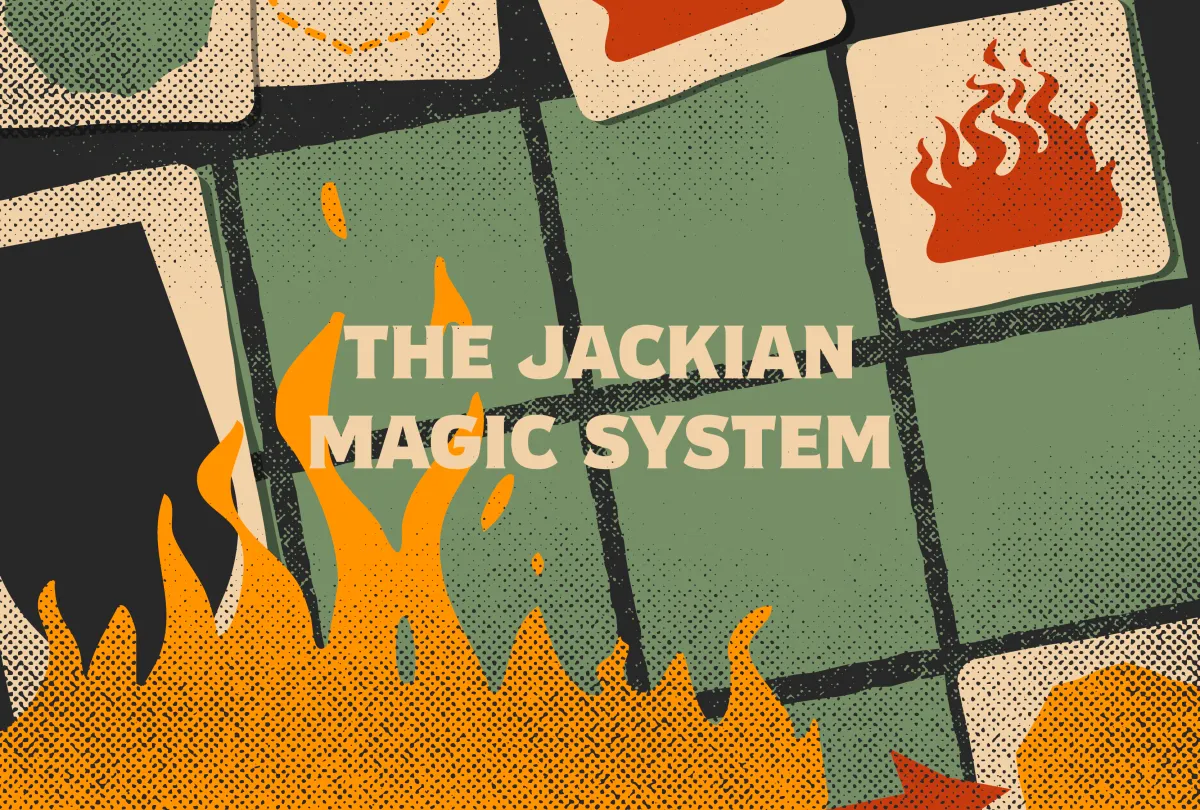
Jackian Magic starts with a wizard's mind, a small impressionable little hovel with the potential to become a formidable dungeon of spirits, demons, and elementals. The more powerful the wizard, the bigger the mind, and bigger the grid. The more powerful the spells, the bigger the spirits, and the more grid they take up.
In this system, we're going to call the spellcasting grid simply the mind.
Preparing Jackian spells.
After a night's rest, a wizard studies their spell book and scrolls to find, summon, and contain their spirits. Then the player arranges them in the mind. The size of the grid and its strategic considerations are the only limits to how many spells can be memorized.
Casting Jackian spells.
Regardless of the system, Jackian magic follows the same basic structure: Every spell either works as intended or it doesn't. If the cast is successful, the spell goes off without a hitch and its respective token remains inside the mind grid. If the cast is a failure, the spell acts on its own.
When a cast succeeds: Resolve the spell's result then mark 1 success for it.
When a cast fails: Resolve the spell's result and failure conditions then mark 1 failure. If a spell moves, grows, or exerts control over the mind, roll 1d20 to determine in which direction (1-5 North, 6-10 East, 11-15 South, and 16-20 West). If the spell moves past the edge of the grid, it escapes out into the world and either disappears or causes trouble.
Recovery from Jackian spells.
Magic recovery mirrors physical recovery. First, remove any prepared spells that can be removed (some might not relinquish territory). After a week's rest, remove any ability score damage and temporary conditions. If a spellcaster is deprived of a crucial need (such as food or rest), they're unable to recover from spellcasting.
System hack example: Cairn 2E
In Cairn, every spell is represented by a singular spellbook that takes up one inventory slot. Which means that "wizards" in Cairn are walking libraries—committed to carrying nothing else besides spellbooks. With the Jackian magic system, those spells are relegated to a single extra bulky spellbook (4 slots), while the prepared spells take up slots in their mind.
Unlike in Cairn 2E's normal system, you must make a Wil Save every time you cast a spell. In the Jackian magic system, there's always a tactical risk with casting. On a failure, the spell exerts control and triggers failure results.
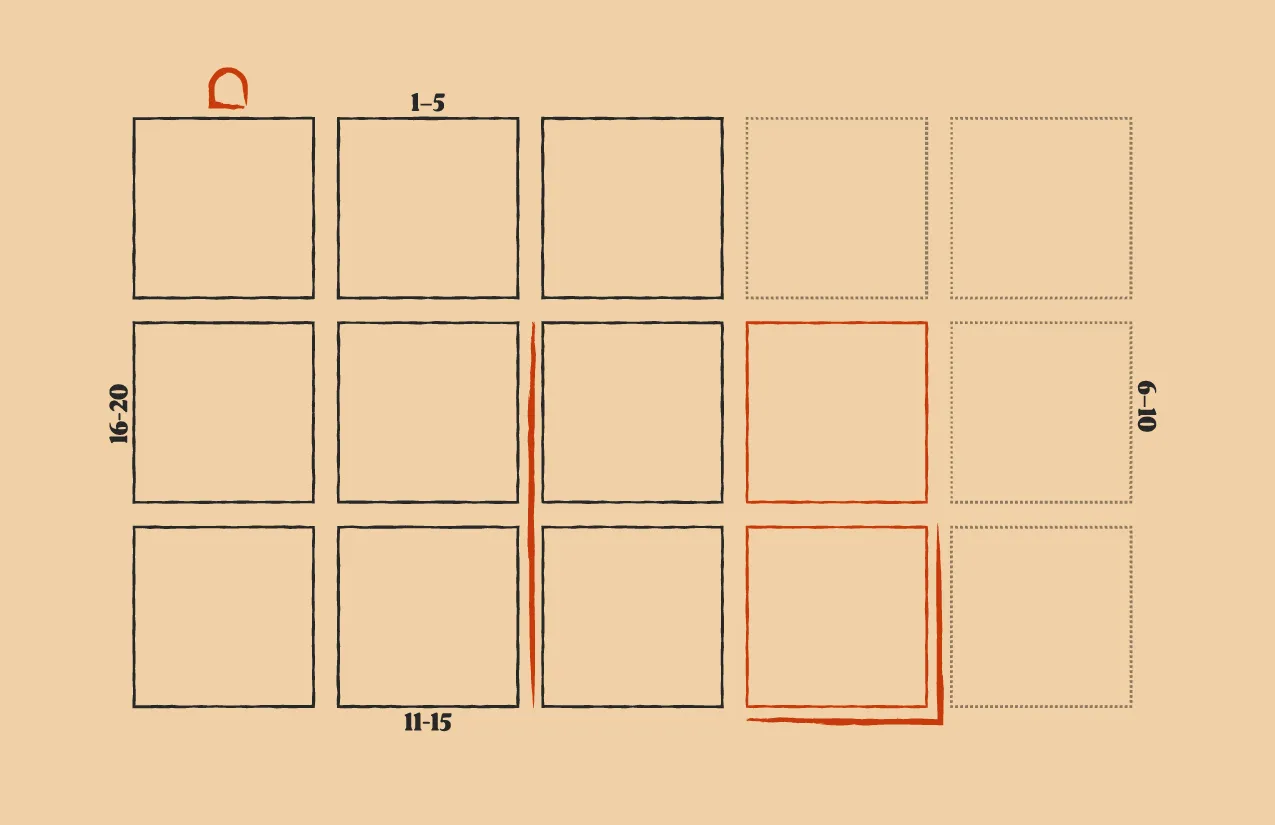
Advancement in the Jackian magic system.
Most of the systems I play don't have traditional leveling systems, so the exact trigger for this advancement is dependent on the system. For my Jackian Cairn 2E hack, a "spellcaster" needs at least three failed saves, or three successes, and a week's rest to grow their mind's grid. While playing, note these three instances:
- Mark every time a spell succeeds (keep track of this progress for each spell).
- Mark every time a spell exerts control and breaks out of the mind.
- Mark every time a spell exerts control and stays inside the mind.
After choosing an advancement, the record is wiped clean, and the advancement process starts over. A player can choose not to grow or change their mind's grid and "bank" their failures for the future.
Unlike failure results, successes on individual spells are persistent. They're never wiped after an advancement. When a player has successfully cast a spell three times, they get a new version of the spell. (This is an optional rule. Maybe too granular. I'm not exploring it in this article.)
Keep. Add one additional empty slot to your mind's grid. Prerequisite: Three casts need to break out of your mind.
Moat. Add an un-breachable side to one slot in your mind's grid. It can border another slot or the edge of your mind. Nothing can break through this moat, if a spell's failure condition in contingent on break out, nothing additional happens. Prerequisite: Three casts need to exert control inside your mind.
Port. Add a "gate" to one external side of a slot in your mind's grid. Whenever a spell exerts control, it always breaks out through the gate. Prerequisite: Three casts need to break out of the mind.
Repair. Remove one permanent condition from the mind. Prerequisite: Three casts need to exert control. It doesn't matter how. This is the default option.
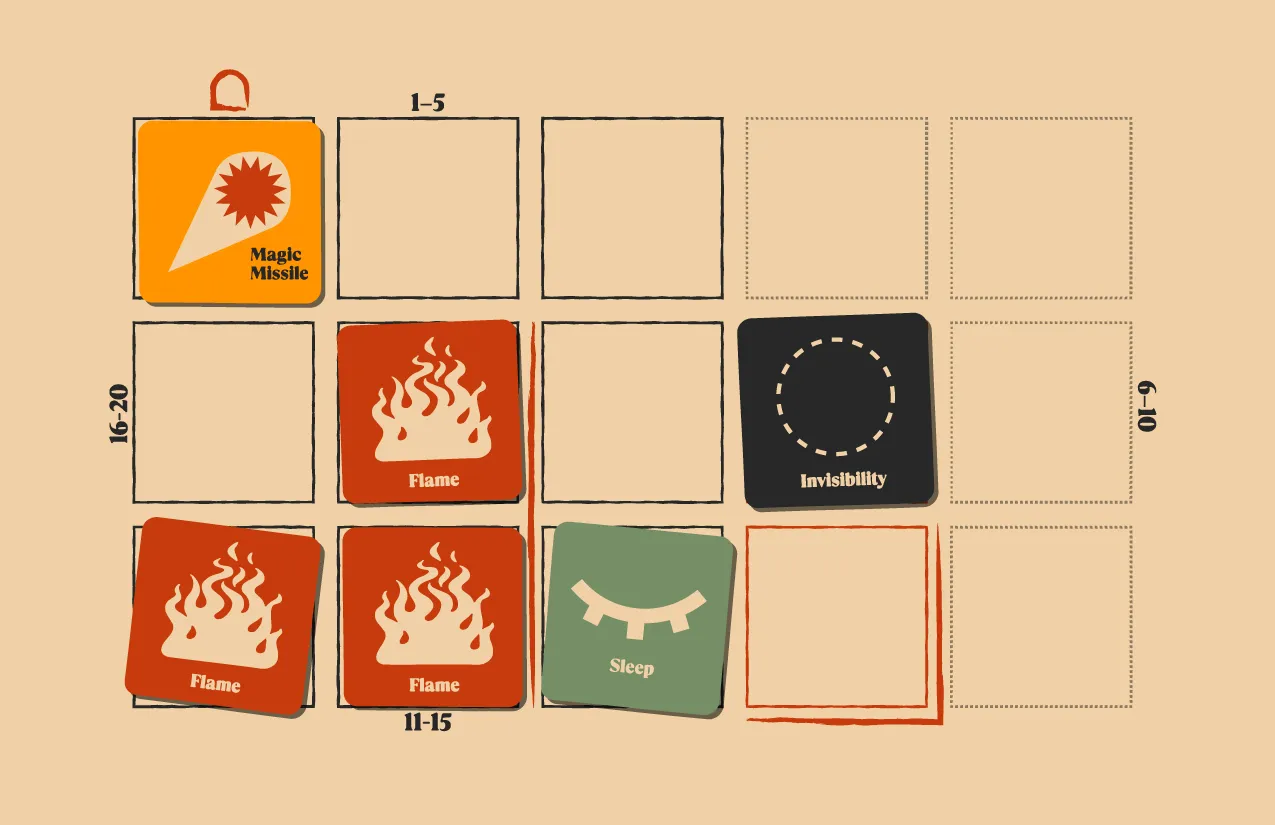
Example Jackian Spell List
Magic Missile. 1-slot token. Hits one target for 1d6 damage. Ignores armor. Failure: The magic missile moves in a cardinal direction until stopped by another spell or the walls of the mind. If it hits a spell, that spell is cast and lost.
Sleep. (1-slot token.) A creature you can see falls into a light sleep. Failure: Add a sleepy condition to your inventory. If this fills your inventory, fall asleep, then remove all sleepy condition tokens.
Light. (1-slot token) One object you can touch shines like a torch. Failure: Bright light shines out of the spellcaster's eyes. To stop the light, their eyes must remain shut. If the spell Dark is in the mind, it is lost.
Dark. (1-slot token.) Extinguish the light of one mundance object you can see. Failure: The spellcaster's vision grows dark, no brighter than candlelight. If the spell Light is in the mind, it is lost.
Fly. (1-slot token.) For one minute, the spellcaster can swim through the air like water. Fly cannot be placed on the "floor" of the mind. Failure: Fly moves one space in a cardinal direction. If it ever ends up on the floor, it's lost.
Invisibility. (1-slot token.) A creature you touch is invisible until they move. Invisibility cannot touch spells on all of its sides. Failure: Invisibility "disappears" before reappearing in an empty slot after a short rest.
Charm. (1-slot token.) A creature you see treats you as a friend. Charm must be touching another spell. Failure: The spellcaster gets the condition "charmed" and cannot harm another creature unless harmed by it first.
Sticky. (1-slot token.) An object you can see becomes extremely sticky. Sticky must be touching a wall of the mind's grid. Anything that touches sticky cannot move in the mind. Failure: Add a "sticky" condition to your inventory. Nothing touching it can be moved without time and effort.
Shield. (2-slot vertical token.) A creature you touch is protected from mundane attacks for one minute. Shield is immune to collisions with other spells in the mind. Failure: Add a bulky "heavy" condition to your inventory.
Flame. (1-slot token.) A small throwable flame appears in your hand. It ignites anything it touches. Failure: Flame creates a duplicate in an adjacent space. If it collides with another spell, that spell transforms it into another flame.
Fireball. (1-slot token.) A torrent of flame erupts from your hands setting a room you can see ablaze. Failure: Fireball doubles in size. On collisions, it consumes other spells. If it escapes the mind, a second version of the spell is cast with the spellcaster at its center. The spellcaster is not immune to this casting.
Portal. (2-slot vertical token.) With one step, the caster teleports from one spot to another they can see. Any spells that collide with portal in the mind teleport to the outside world or another mind grid with the portal spell. Failure: A spell touching portal is sucked out and immediately cast at the target destination.
Gust. (1-slot token.) Push or pull one target 10-feet toward or away from you. Failure: Roll for a direction, then push all spells in a straight line from that direction one space away from gust. Follow any collision rules.
Shrink. (1-slot token.) Touch one object or creature and halve its size for one minute. Failure: Add a "shrunk" condition to your mind. It doesn't go away until after a short rest. If shrink collides with another spell it halves its size. If it's already 1 slot, it's lost.
Grow. (1-slot token.) Touch one object or creature and double its size for one minute. Failure: Double the size of grow. If grow collides with another spell it doubles its size. If this would overfill the mind, lose as many spells as you need to make space. If this triggers an escape result, (like with Fireball), resolve it.
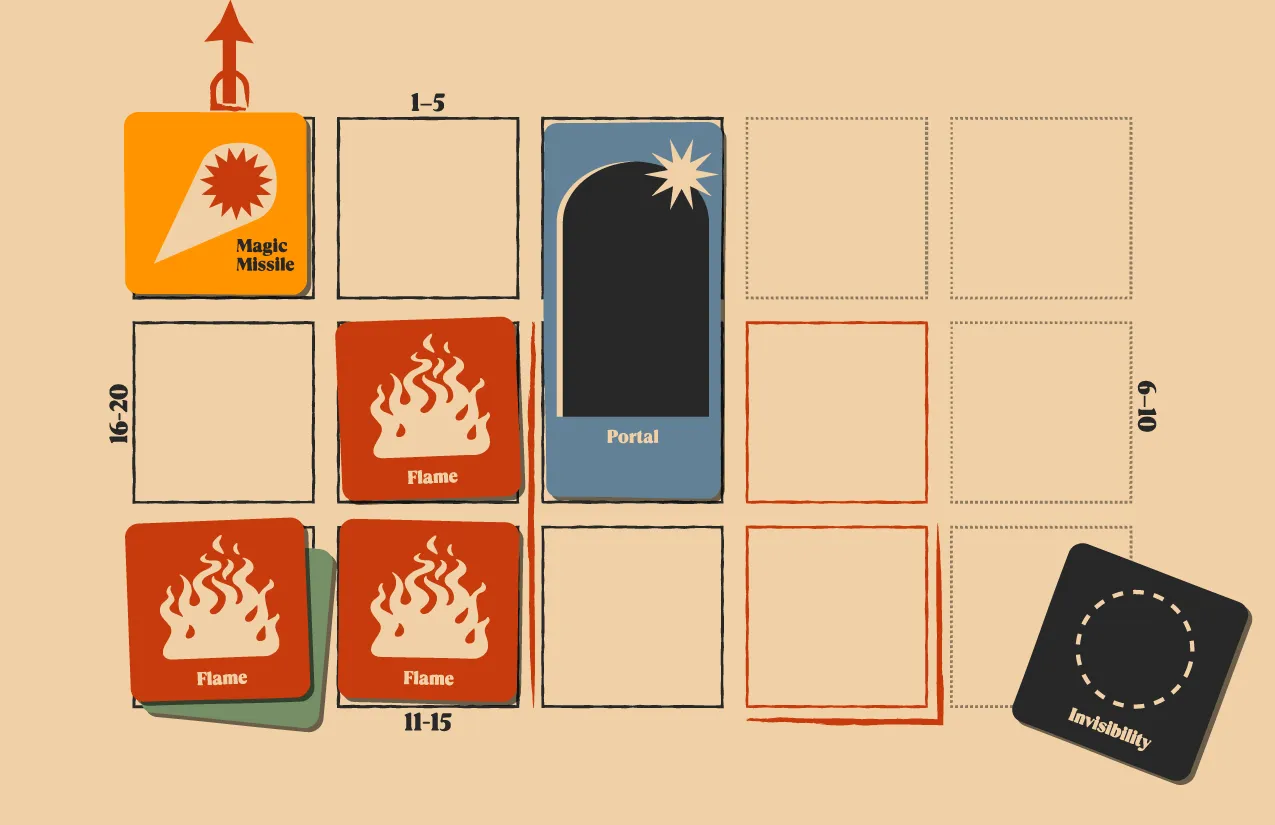
The theory behind Jackian magic.
Jackian magic combines two influences. The idea of spellcasting in Dungeon Crawl Classics and my love for tile-laying/deckbuilding board games. As is often the case, when I first heard of DCC's magic system, I imagined a drastically different experience than the one on the page.
Both systems are maximalist. Both systems transform your spellcaster. The intended goal of the Jackian magic system, though, is to create something more innately interactive. By design, Jackian spells are more reliable (the spell always happens), more predictable (the spell has an internal logic), and more interactive (outcomes vary depending on player choice).
When Jackian spells go haywire, they often set off chain reactions, escalate, and reveal hidden strategies and patterns. I want players to brainstorm their spellbooks and design their mind's grid like they might a tableau or deck of cards. What happens when you place the spell shield in your mind just so it interacts with other spells on the grid? That's my kind of system.
How to design Jackian spells.
This system hasn't been tested, so user results may vary. Here's what I think needs to go into every Jackian spell to make them feel suitably magical.
All Jackian spells have ≥1 prep requirements:
- Placement requirements. For example: Must be touching a wall or spell.
- Relationship needs. For example: Need to be prepped with another spell.
- Lore requirements. Maybe some spells require more STR or certain food.
- Size/shape differences. Some spells take up more or less space.
All Jackian spells have ≥2 failed cast results:
- Transform. For example: double in size, change shape, or multiply.
- Move. Usually triggering collision results or violating placement requirements.
- Collision results. Something happens if the spell bumps into another spell.
- Escape results. By default, most spells are lost, but some explode or go wild.
- Create mind conditions. These temporary conditions fill the mind's grid.
- Create physical conditions. These temporary conditions fill the inventory.
Final thoughts on Jackian magic.
In an ideal world, this subsystem finds a loving home in a game with lots of cool inventory management mechanics. The kind of game where tile-laying and engine-building feels like a natural extension of mechanics already there. None of my projects need a super in-depth magic system right now, so feel free to steal this for your own projects—or make some spells for it and tag me online.
If you're interested in reading more about this idea (or the ideas that spawned it) check out these resources:
 Clayton Notestine
 Sam Dunnewold
 Skeleton Code Machine
Explorers Design is a production of Clayton Notestine. If you liked this article, please consider liking, sharing, and subscribing. Members who support me get access to a few bonus tools and templates as a thank you for all the help.