How to Pick a Page Size
There's more to an rpg's format than cost and page count.

The format impacts everything.
Choosing a format or "paper size" will affect everything about your project, so I recommend thinking about it early. The earlier the better. The sooner you start thinking about format, the sooner you start thinking about what your project actually is.
Examples in this article are estimates based on what I can glean from measuring the dimensions of books. The following advice isn't going to make any sense if you're not planning on printing a book or publishing a printable PDF. If you're sticking to digital, consider HTML. Otherwise, keep reading.
There are three philosophies to consider when picking a format.
The medium is the message.
Marshall McLuhan, a Canadian communications theorist, proposed this: the medium, not the message it carries, should be your primary focus. Sounds crazy, right? Don't worry, McLuhan clarifies:
The title "The Medium Is the Message" is a teaser—a way of getting attention. There's a wonderful sign hanging in a Toronto junkyard which reads, 'Help Beautify Junkyards. Throw Something Lovely Away Today.' This is a very effective way of getting people to notice a lot of things. And so the title is intended to draw attention to the fact that a medium is not something neutral—it does something to people. It takes hold of them. It rubs them off, it massages them and bumps them around, chiropractically, as it were, and the general roughing up that any new society gets from a medium, especially a new medium, is what is intended in that title
It makes reasonable sense when he puts it that way. The medium is not neutral. It tells the audience something separate from the content itself. A game stapled together as a zine conveys a different message than that same game in hardback—or a boxed set. Similarly, it decides the book's neighbors on the shelf. Many OSR games line-up together, while games like MIRU I and TORQ stick out. I cannot substantiate this, but a lot of my local game stores arrange books by type and size, so even if your game has nothing in common with a big box game, it might still end up wedged between them.
The page size says something about your work. It conditions the audience. Some of these things are overt, like the production quality. Others more subtle, "This is the same size and shape as a punk rock zine." It's all about context. Use it wisely.
The message has its mediums.
In addition to the medium being the message, we can't forget some messages work better in different mediums than others. There's a reason why games like Call of Cthulhu are US Letter—if the book were smaller, it would be impossibly thick. (They could make the book shorter, but that's a different endeavor entirely.) This is also why games in US Letters tend to feature lots of art—the pages would be barren or text-heavy without them.
There are qualities in a game or adventure that can be helped or hindered by its format, primarily because the page's dimensions are a design constraint.
Projects with lots of writing and very few pictures benefit from narrow formats like the half-letter and US Trade. It gives them a narrower canvas that optimal line widths seem to fit naturally. It gives them an emphasis on vertical space to do paragraph breaks, dialogue, and even lists.
Similarly, books that are heavy on art or graphics tend to do well in larger, wider formats. Maps almost always look better on square or landscape-oriented pages, because it gives them the opportunity to spread out, depict vistas, and provide context without fear of the margins. Similarly, columns get the space they deserve when they're not being crammed into narrow formats like A5 or US Trade.
There are entire layouts, like the Swiss modular grid, that cannot reach their full potential without ample paper to conquer.
The medium has a price tag.
For most designers, the deciding factor is economics. Printers, especially the print-on-demand varieties, have a limited selection of paper sizes—anything beyond those sizes increases costs. That's because uncommon page sizes require pages to be cut (more labor), speciality suppliers, or savvy partners.
In other cases, the price is not in the production but the shipping. Not all books and zines fit in a padded envelope. Not all books pack neatly into a box. Sometimes it's cheaper to ship books in big formats than small ones because thickness dictates packing material. That's something you don't realize until you're buying bubble wrap—a curse I wouldn't wish on anyone. Not even Monte Cook.
If there's one thing publishers like, it's a format they can crunch on a spreadsheet. The moment you drift away from the standard sizes, like A5 and half letter, fulfillment accumulates unknowns—hidden costs.
So what's the ideal format?
You'll have to weigh all three of the above consideration when looking at sizes. There are too many to list here. Before colonialism, globalization, and capitalism, every country and every printer had its own collection of sizes based on equipment, sourcing, and cultural norms. Now, most countries use the same standard sizes with a few legacy formats floating around.
Here are some of the most common sizes:
International ISO 216
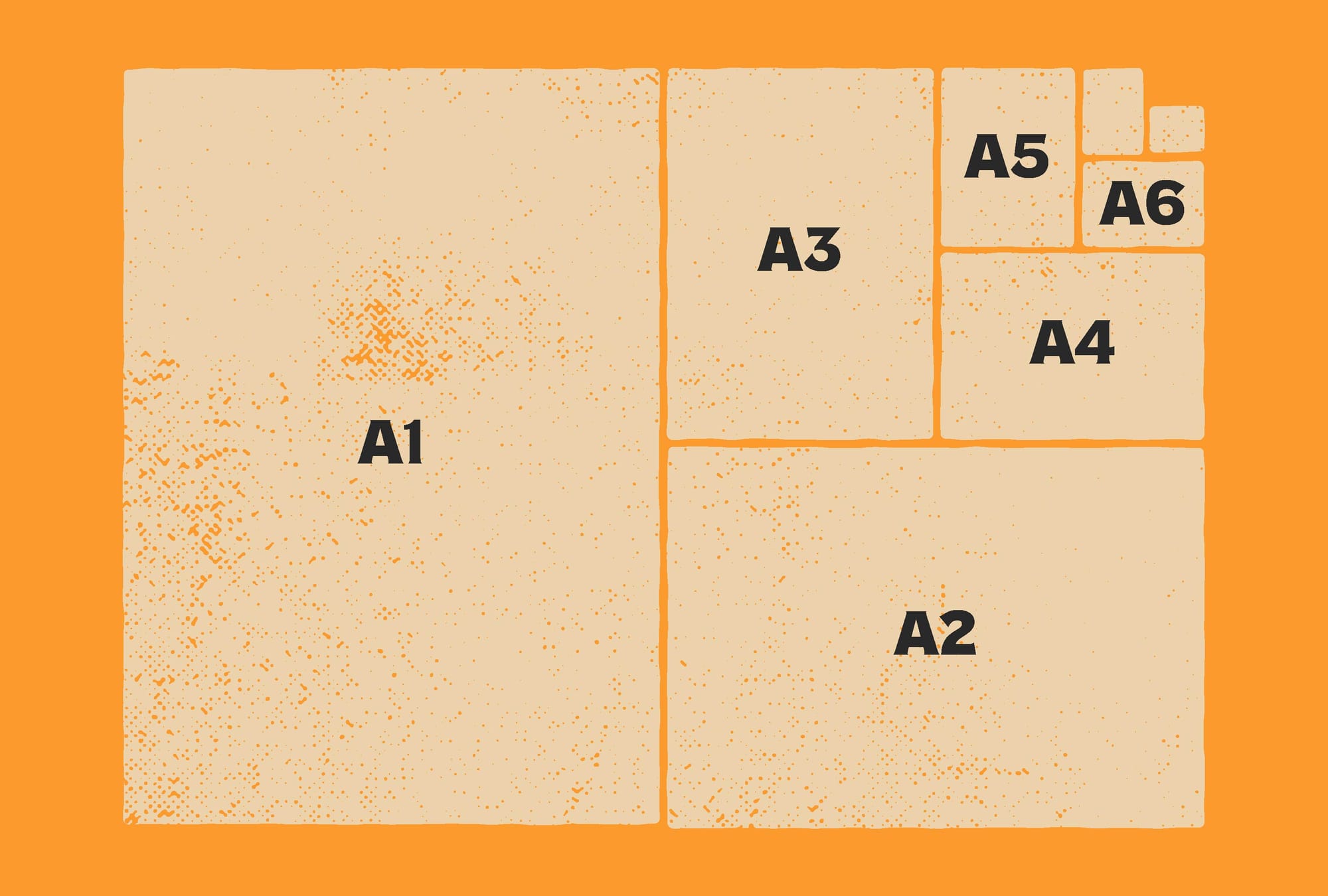
This is the collection of formats I'd recommend most of the time. The international standard or ISO 216 is great because the proportions remain the same when you change dimensions. If you go up a size, like A4 to A3 (the smaller the number, the bigger the sheet), it's twice as big. Go down a size, and it's that page folded in half. You might not realize this now, but that feature can come in handy.
The ISO 216 includes three different series or varieties. The A-Series is the most common and widely available. It's for standard print jobs. The B-Series is for specialty printing (like books and marketing collateral), it's rare and found almost exclusively at big print shops. And then there's the C-Series, a companion collection just for envelopes that fit the A-Series.
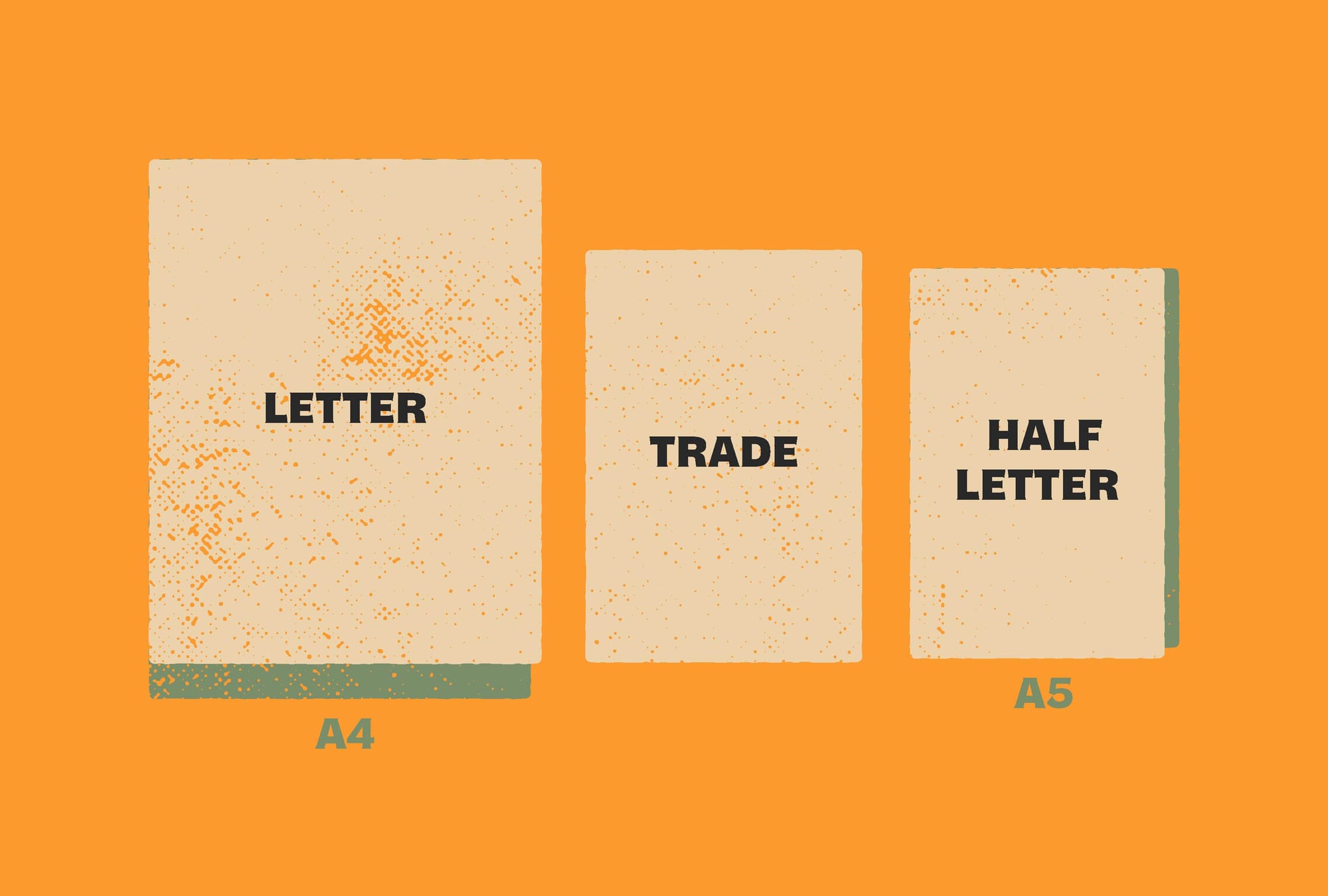
A4. (210 × 297 mm) The standard size for at-home printers and magazines. It's a little taller and narrower than North America's US Letter but plenty ample. If your layout utilizes rows for organization, the A4's taller proportions accentuate them. Examples include The Monster Overhaul by Skerples, His Majesty the Worm by Josh McCrowell, and Ultra Violet Grasslands by Luka Rejec.
A5. (148 × 210 mm) The A5 is the zine-sized format of the A-Series. It screams indie and has great proportions for art and copy. It's marginally shorter than US half letter and marginally wider—a benefit when you have art. Most art pieces benefit from wider canvases. There are hundreds of examples in the wild including, Mausritter by Isaac Williams, Brindlewood Bay by Jason Cordova, and Mork Börg by Pelle Nilsson and Johan Nohr.
A6. (105 × 148 mm) Even smaller than A5, A6 is the size of your average postcard and can fit in the average jacket pocket. A lot of rpg projects won't fit this size, and anything thick will be a pain to read, but if you've got something light, there's nothing better. This is an easy format to ship, slip into packages, and carry around conventions. Examples include Dungeon Cats by Tiger Wizard and Death Cut in Stone by Midnight Oil Publishing, and
B5. (176 × 250 mm) The B-Series's sizes slide between the A-Series sizes. B5 is bigger than A5 but smaller than A4. I love it. It's criminally underused. Big enough to fit complex layouts but small enough to hold and cart around. You probably won't be able to find B5, but you can find close approximations, like Crown Quarto and 17 x 24 cm books. (More on those later.) Books that are roughly the same size include Vaults of Vaarn 2E by Leo Hunt, Trophy Dark by Jesse Ross, and Neverland by Andrew Kolb.
Standard US Paper Sizes
Standard is a funny word for the American system. Besides their shared fear of the metric system, most US paper sizes have nothing in common with each other. The dimensions and proportions change depending on their use case.
There are lots of sizes in this system, including tabloid, legal, and junior legal—I'm not covering those. In addition, America has flirted with its own version of the ISO system, the ANSI and the ARCH (an entire system for architects). None of these matter because they're too niche or too big to find and use commercially.
US Letter. (8.5 × 11 in.) The standard size for at-home printers and American workplaces. It's slightly wider and squatter than the A4—which has its advantages. If your layout uses multiple columns or a modular grid, you'll appreciate the wider dimensions. You've likely known this size your entire life, it's the format used for Dungeons & Dragons by Wizards of the Coast, Call of Cthulhu by Chaosium, and Daggerheart by Darrington Press. It's a great format with underutilized strengths.
Half Letter, Digest, and Small Trade. (5.5 × 8.5 in.) This is one of the few times where a format in the American standard is directly related to another. It's often compared to A5 but it's taller and narrower. I enjoy the digest size. The narrower proportions compliment long copy, rewarding designers who use lots of paragraph breaks and lists (those designs eat up vertical spacing). Games like Mothership by Sean McCoy, Thousand Year Old Vampire by Tim Hutchings, and Blood Borg by Adam Vass use the digest format.
US Trade. (6 × 9 in.) This is a popular size for business, fiction, and non-fiction books in the States. Slightly bigger than the half letter with an extra half-inch on both sides. It feels like a lot more. The extra width accommodates thicker books with big spines and gutters, while the added height plays nice with typography. Technically, this format doesn't exist within Standard US Paper Sizes, but it's popular enough enough that I'm including it here. US Trade is used for Blades in the Dark by John Harper, Deathmatch Island by Tim Denee, and Death in Space by Christian Plogfors and Carl Niblaeus.
Other Popular Sizes
The A-Series and Standard US paper sizes are a fraction of what's out there. Visit any library and you'll find books cut to a variety of sizes. Many of these overlap with each other. Some don't have a name. Here are a few you'll find in the wild.
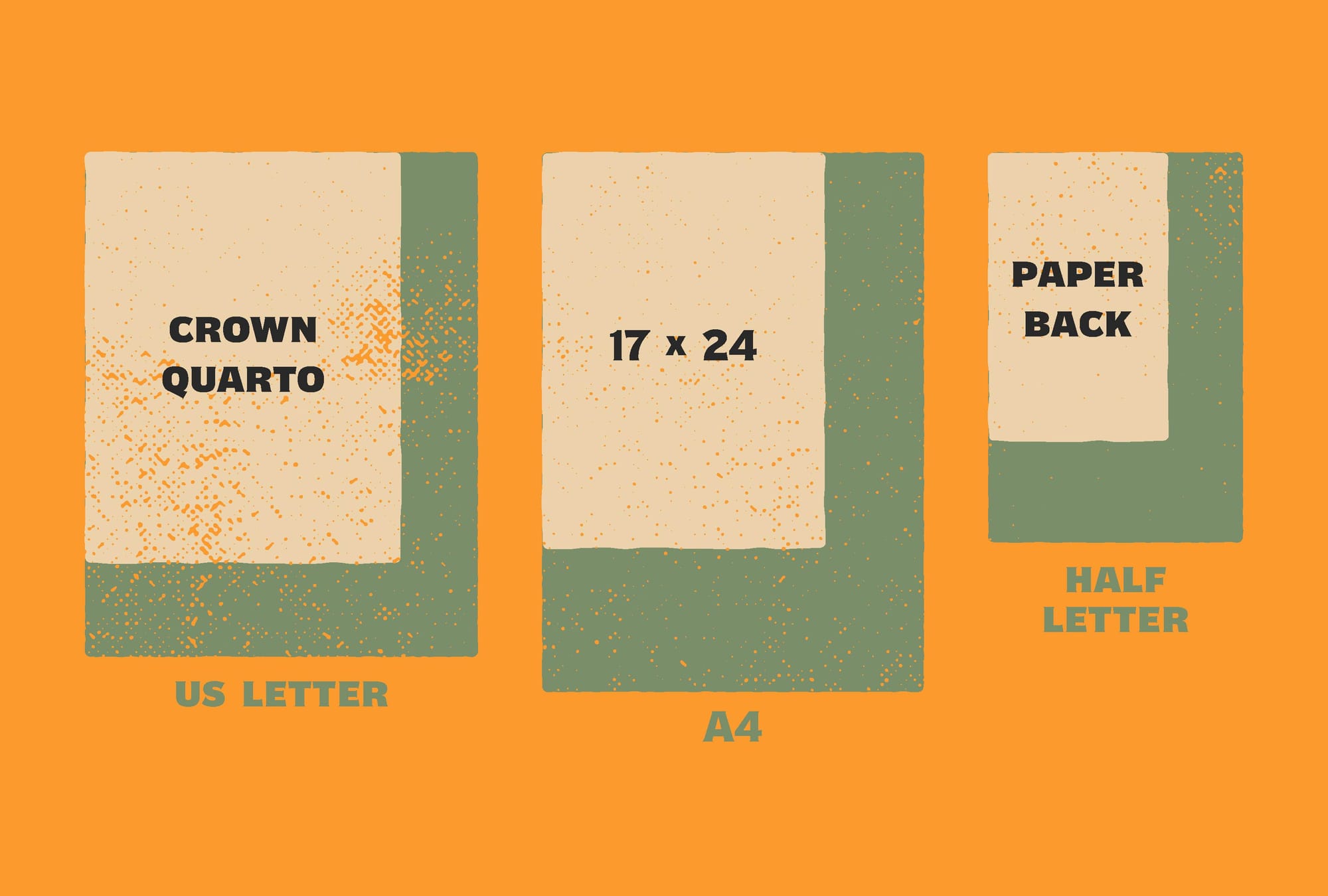
Pocketbook or "Mass-Market Paperback." (4.25 in × 6.87 in.) This size is slightly larger than A6. You've seen it in bookshops, airports, and corner stores with Fabio on the cover It's the mass-market paperback, still in widespread use today with cheap pulp paper and text-heavy interiors. There are lots of "paperback" book sizes with varying sizes, so make sure to doublecheck your book for the exact dimensions. I think this format is waiting for art-free games.
Square. (Varies) Square-shaped formats come in all sizes and are frequently used for photography and children's books. It's a great format if your game has lots of art or whitespace. Not just because they fit, but because square pages accommodate all kinds of dimensions like landscapes, portraits, and sprawling maps. You can fit those things in a standard book, but the square format poses fewer headaches. Two examples of this format include Wanderhome by Jay Dragon and Babes in the Wood 2E by Adam Vass.
Landscape. (Varies) Now, you might think landscape confers the same benefits as square formats—but you'd be wrong. The dimensions of your art and copy will always dictate the ideal page ratio. Landscape is great for (surprise) landscape photos and short multi-column layouts. Tall art tends to struggle in this format. Examples include TORQ by Will Jobst and MIRU I by Hinokodo.
Comic. (Varies) If you don't use a comic book format for your superhero rpg, expect grumbles from me. There are three standards in comics, not including comics made in generic sizes like digest and A5. The standards, based on different comic book eras, are slightly larger than most generic formats. Unfortunately, that also means you can't print and fold them like US half letter and A5 without some trimming.
Crown Quarto (19 × 25 cm) This popular book size lives in the form of textbooks and cookbooks. That should tell you about its strengths. If you're project features a lot of art, cartography, or intricate layouts—you can't do much better than the Crown Quarto. It walks a fine line between the A5 and the A4. Big enough to accommodate creative layouts. Small enough to feel portable.
17 × 24 (17 × 24 cm) Not all sizes have names. This industry standard fills a niche only slightly smaller than the B5. It confers all the benefits of that size and the Crown Quarto but at a slightly smaller form factor. Ultimately, the choice between the two is decided by whats available. This size is particularly common in the EU.
What to do when picking formats.
You'll find surprising variety out there. A lot of them will work great, which only choosing a size harder. So, if you're looking at formats, I recommend you do this.
Start with the familiar.
Don't go wild unless its the perfect fit. TORQ, a game about cars, is the same size as your average car manual and fits in a glovebox. Will Jobst doesn't get enough credit for how cool that is. Most rpgs don't lend themselves to ideas like that. Stick to what you like and what your ideal player likes. If you're making a Mothership zine, it's probably a good idea to use one of the popular sizes in that community.
Create a real-life demo.
Nothing beats a physical prototype. Print off your cover and a variety of spreads, cut them to size, then stick them on a real book with the same format. How does it feel? What does it look like on a shelf? Does it feel right? The computer screen can never recreate what a book actually looks and feels like in person. This is a mandatory step, especially if you plan on a big print run.
Focus on the work.
It's easy to overthink the economics, the culture of play, and other external factors. It's a lot easier to stay focused on the work—what does it need? What format is going to play to your project's strengths? If people only thought about the market, we'd still be publishing almost exclusively in US Letter. If picking a format is getting in the way of starting a project, it's better to invite mistakes, and pick whatever will make your art and copy shine—or just work.
Additional Reading
Like other articles in this series, I've shamelessly stolen and translated information from other sources. Smarter minds have toiled over the page size debate. You can find those sources, and other articles by me, below:

 Marta Dec
 Jeremiah Shoaf
 Clayton Notestine
 Clayton Notestine
Explorers Design is a production of Clayton Notestine. If you liked this article, please consider liking, sharing, and subscribing.