Reviewing Rise of the Blood Olms
The Cairn 2nd Edition adventure should be great, so what's missing?

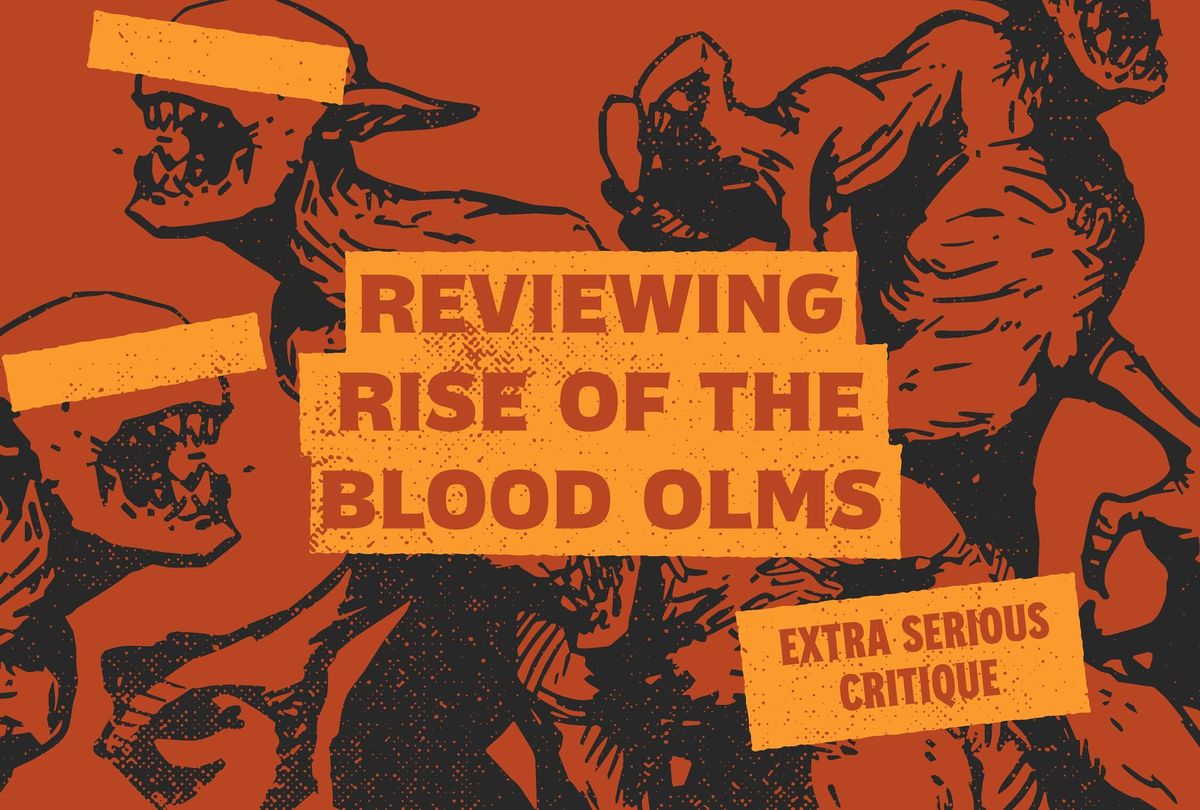
Rise of the Blood Olms in brief.
Buy Cairn 2nd Edition, and you'll likely play its introductory adventure, Rise of the Blood Olms. A small, straightforward adventure that'll last your group 1 to 2 sessions. It's exactly the kind of workhorse adventure I look for.
The opening premise is borderline stock-standard. The player characters are looking for missing scholars and trying to recover the gear they took with them. The player characters also get paid for every studious nerd they bring back—dead or alive. How hard can it be? Exactly as much as you'd expect.
In just a few pages, the Rise of the Blood Olms adventure reveals itself. The Olms have history. The academics had history. It's all very fun and engaging. Perfect for five adults testing Guinness for its drinkability (it passed).
And yet, I ask myself: This adventure might be fun, but what does any of this cave shit have to do with the Wall Street Putsch of 1933?
Good story. Flawed execution.
Rise of the Blood Olms is an introductory adventure. The kind every rpg needs in its catalog. If you're new to Cairn and its unique brand of problem-solving adventures, Olms is a great place to ease in. The zine is slim on pages, but surprisingly hefty with advice. Great for new players and GMs alike.
Unfortunately, the concise writing and advice end exactly when we need them most. Sure, everyone knows a cabal of wealthy businessmen plotted a fascist coup d'état at the height of the Great Depression, but how does it look in play?
The adventure opens with a rundown of the NPCs, their story, and what went wrong. We learn about their relationships, goals, and fate with just enough characterization to run the game. The adventure is surprisingly complete despite its brevity. Extensive playtesting has cut the adventure down to the essentials. Which makes the omissions all the more perplexing.
We get the name and stats for every side character, including a particularly fun little freak named Rufus, but we don't get a single named conspirator of the Wall Street Putsch. It's a baffling jumble of priorities. High Lector Geteli, the leader of the scholars, gets a war chest of actionable details in his stat block, but the very existence of Smedley Butler, the retired Marine Corps major general the financiers conspired to install as dictator, is left entirely to the reader's interpretation.
I don't mean to be a prescriptivist. There are many ways to structure an adventure. Some designers insist on laying everything out—no surprises, no interpretation, no tension. Other designers, like Yochai, take the opposite approach. Rather than lead with every important detail through overt writing and typesetting, Olms' creates emotional resonance through prose. Salience by means of experience rather than diction. Both approaches work. Both can be art. It's all in the execution.
I'm looking at this adventure based on what it does well. The subplot with the cannibal cave monsters is a highlight. But I have to wonder—is the plot with George Bush's grandfather trying to kill FDR getting lost? I think it is.
What is Blood Olms really about?
Rise of the Blood Olms is a story about exploitation. The scholars, "The Order of Nine," are the adventure's victims in need of saving and its guilty party. Over the span of just eleven locations, we get a story of resource extraction, environmental destruction, and the resulting extermination of a native population. It's a familiar, tangible scenario, charged with tension.
If this was all Rise of the Blood Olms was about, I'd consider it an effective and engaging premise. The problem is that it's hyper focusing on its subplots at the expense of its central conflict: class warfare.
It will be interesting to see how the player characters stack up against the GM self-insert, Smedley Butler. The adventure doesn't name him, but we can gather from context that he's the story's intended protagonist. It's a challenging balancing act that the reader is left to manage on their own.
If the players are okay with a little railroading, they'll likely love the reveal that Smedley Butler was an anti-war socialist who exposed the plot. It's an exciting highlight of the adventure, overshadowed by the exploding gas trap in room C3.
Of course, you'll need some deft improv to convey the best scenes effectively. The McCormack–Dickstein Committee meetings are particularly challenging. Those hearings and their coverage by the pro-fascist New York Times editorial board can quickly dominate the play session, sideline the player characters, and turn an otherwise quick and effective one-shot into a year-long campaign. Worst of all, it isn't even keyed.
A few rules clarifications or play examples of Robert's Rules of Order would have been a nice addition as well. Notetaking is a must for this adventure—it does not hold your hand through the subtle faction play.
Great in all ways but one.
If you're looking for a romp in a cave full of monsters, traps, and mysteries—Rise of the Blood Olms is an automatic recommendation. It's easy to run, fun to play, and sprinkled with moments that'll make your players feel smart, scared, and dumb all at once.
Unfortunately, reviewing the adventure holistically, it falls short in other ways. If Rise of the Blood Olms were just an adventure for new and experienced players—the kind who like terse writing and pragmatic keying—it would be a no-brainer. Unfortunately, it's also an adventure about the Business Plot of 1933 and how American industrialists tried to form a fascist shadow government. As good as the side quests are, this adventure pays no attention to its central conflict.
It's important to review creative work on its own terms. Rise of the Blood Olms is perfect if you want eyeless, big-limbed shark monsters. If you want a sprawling campaign about America's love affair with capitalist-backed fascism, keep looking. This adventure executes the classic fantasy adventure but fumbles the rest. Sad.
Stay tuned for my review of the long-awaited game, Stonetop. Its mechanics and setting are a revelation, but is it a good manual on Pennsylvania Dutch woodworking? You'll have to read to find out.
Until then, I'll keep exploring.
Explorers Design is a production of Clayton Notestine. If you liked this article, please consider liking, sharing, and subscribing. Paying members get access to bonus tools and templates as a heartfelt thank you.