How to Design Lists in RPGs
User-friendly definitions, tips, and tricks for graphic design in rpgs.

What kind of lists are there?
Few mediums employ the itemized list like tabletop rpgs. We're in the company of cookbooks, textbooks, and warehouse clipboards. Should you choose to deploy lists, they can be incredibly versatile at conveying information.
Bulleted Lists. Before computers, they didn't exist as we know them today. They were less standardized and more expressive with fleurons and manicules. Bulleted lists are great for items with no technical order.
Numbered Lists. The numbered list is great for items where the sequence matters. In bulleted lists, the order is solely for hierarchy and dramatic purposes. In numbered lists, the order is procedural, like steps for character creation.
Lettered Lists. We don't see lettered lists that often in rpgs. They can convey two different things. One, that there's a choice between the items on the list. Or two, that there's a prescribed order that's procedural but not strictly so like in numbered lists.
Plain Lists. Since the days of Ea-nāṣir, unadorned lists have been created using line and paragraph breaks. If you're going for a minimalist, unobtrusive reading experience, the old fashioned line break and occasional indent is perfect.
Tables. It's important to recognize that many tables are ornamented lists. It's only when the table has three columns or visually cluttered articles that the table shines. If you find yourself making tables with two columns, consider the list.

Do you like design in tabletop roleplaying games? Sign up as a free member and get the next issue in your inbox.
Are lists right for your book or zine?
Lists are another layer of information. This layer is "loud"—designed to stand out. Deploying a list is like dragging something into the foreground. It's the author explicitly telling the audience to pay attention and remember.
Does this mean lists are anti-prose? Not exactly. Like any writing device, lists can create tension, paint pictures, and surprise the audience. Read Robert Caro's The Power Broker or McSweeney's many lists to see how.
Should I use lists in my projects?
There's no universal answer here. Every game and adventure is different. Some use lists extensively, some use lists sparingly, and some ignore them altogether. Great work isn't decided by what you use, but how you use it.
How will the book or zine be used? Some games are all about convenience. No extra prep for the game master, just skim the adventure and keep the relevant pages open. Well-executed lists are often perfect for this use case.
What is the planned reading experience? Some games want their readers to indulge in them like a novel, so they use novel-like paragraphs and devices. Others aim for instructional reading. Some aim for a magazine-like reading experience. All three will use lists differently—if at all.
How defined are the details? Some games revel in the creation of fictional worlds while others leave everything up to play. The more definition there is, the more lists might provide structure. In a game where every room is packed with details, a list can make sure some details more prominent than others.
Advice for designing lists.
The balance between lots of lists, some lists, and no lists is different for every project, but let's assume you want to use them. The following suggestions are just that—suggestions. Depending on the infinite variables in your project, some of these will feel less applicable or "true" than others.
I'm still practicing my adventure/game writing skills, so think of my examples as rough sketches. There's going to be plenty "wrong" in these as well, but hopefully you see the broad idea.
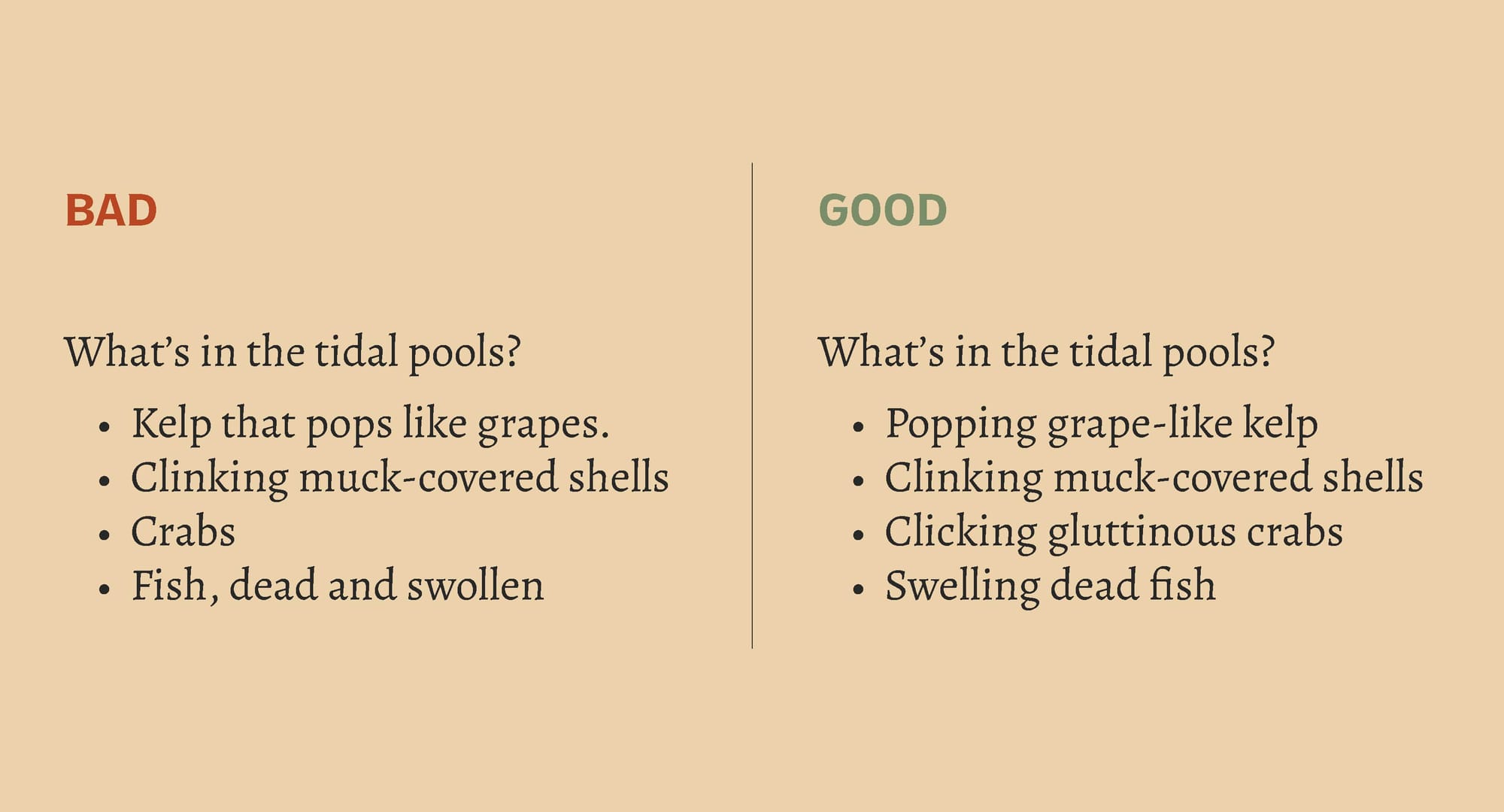
Make items in the list structurally parallel.
The more the items diverge from each other in structure, the less useful and legible the list becomes. Items in a list should resemble each other syntactically—all articles or all sentences. All starting with verbs or all starting with nouns. Short or long. Don't mix and match drastically different items unless you're doing it for dramatic effect.
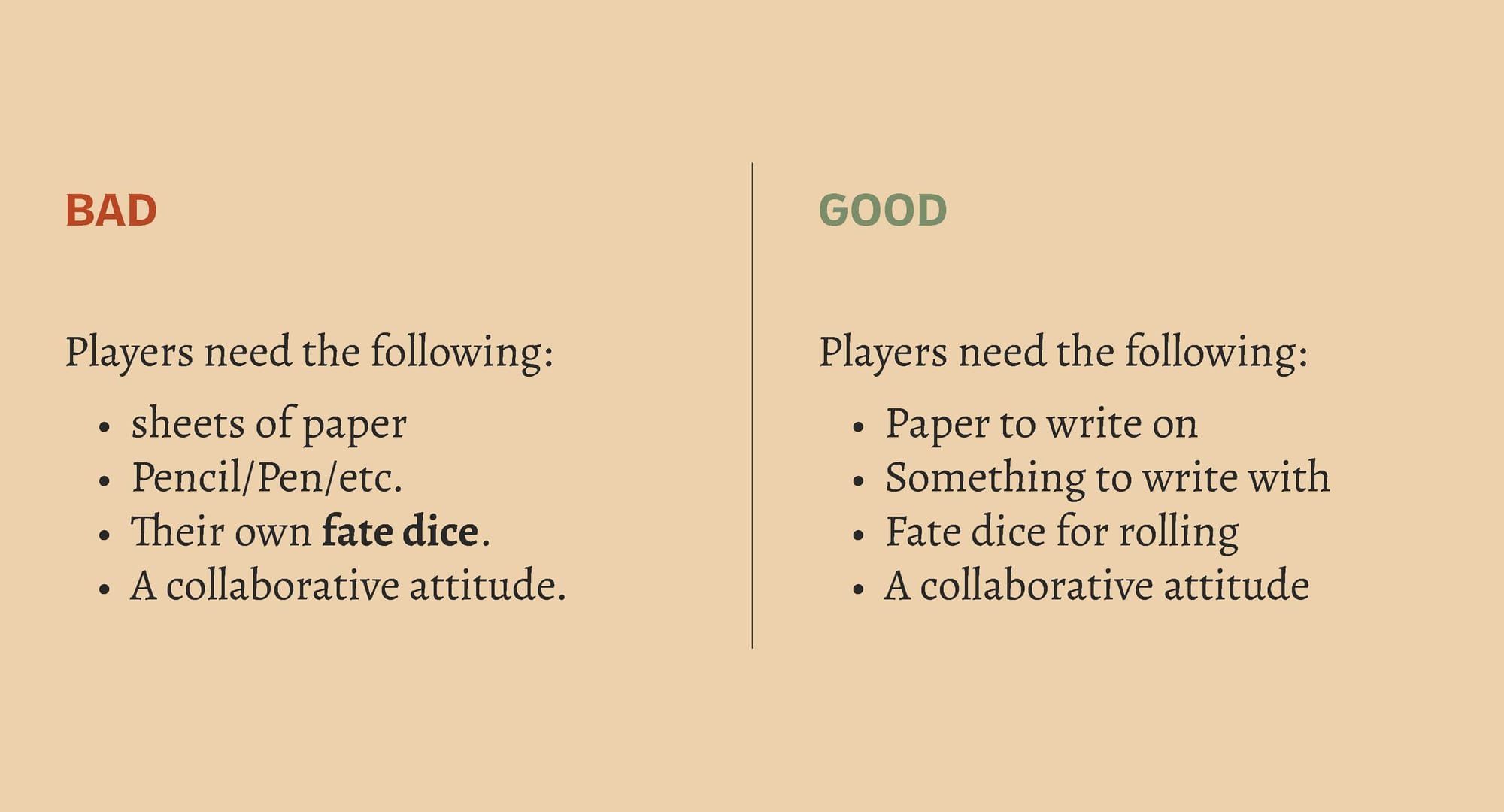
Keep formatting consistent within the list.
If the list items are sentences, capitalize the first word. If they're fragments, make sure everything in the list is a fragment. Some publications capitalize the first word in their fragments, others don't—it's up to you. If you're using sentences, always end with punctuation. The rule that periods don't belong in lists is a myth. In ideal circumstances, attention-grabbing formatting is limited to the start of each successive bullet. Bold words in the middle of lists can make them harder to read.
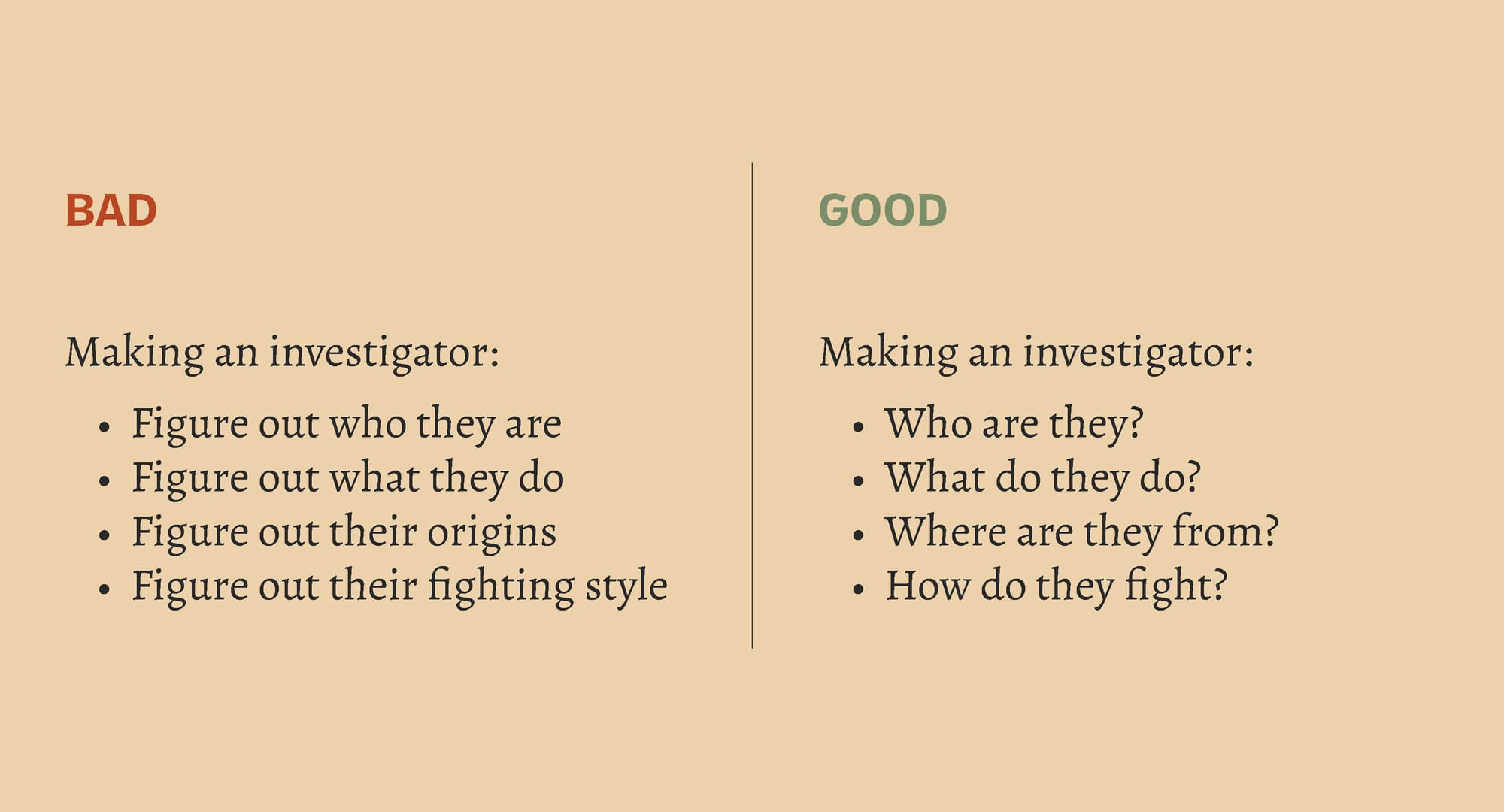
Avoid value-less redundancies.
Avoid starting each item with the same word or words unless you're using it for creative tension. The purpose of repetition is to make what's different more apparent. Repetition without substance makes lists wordier and harder to parse.
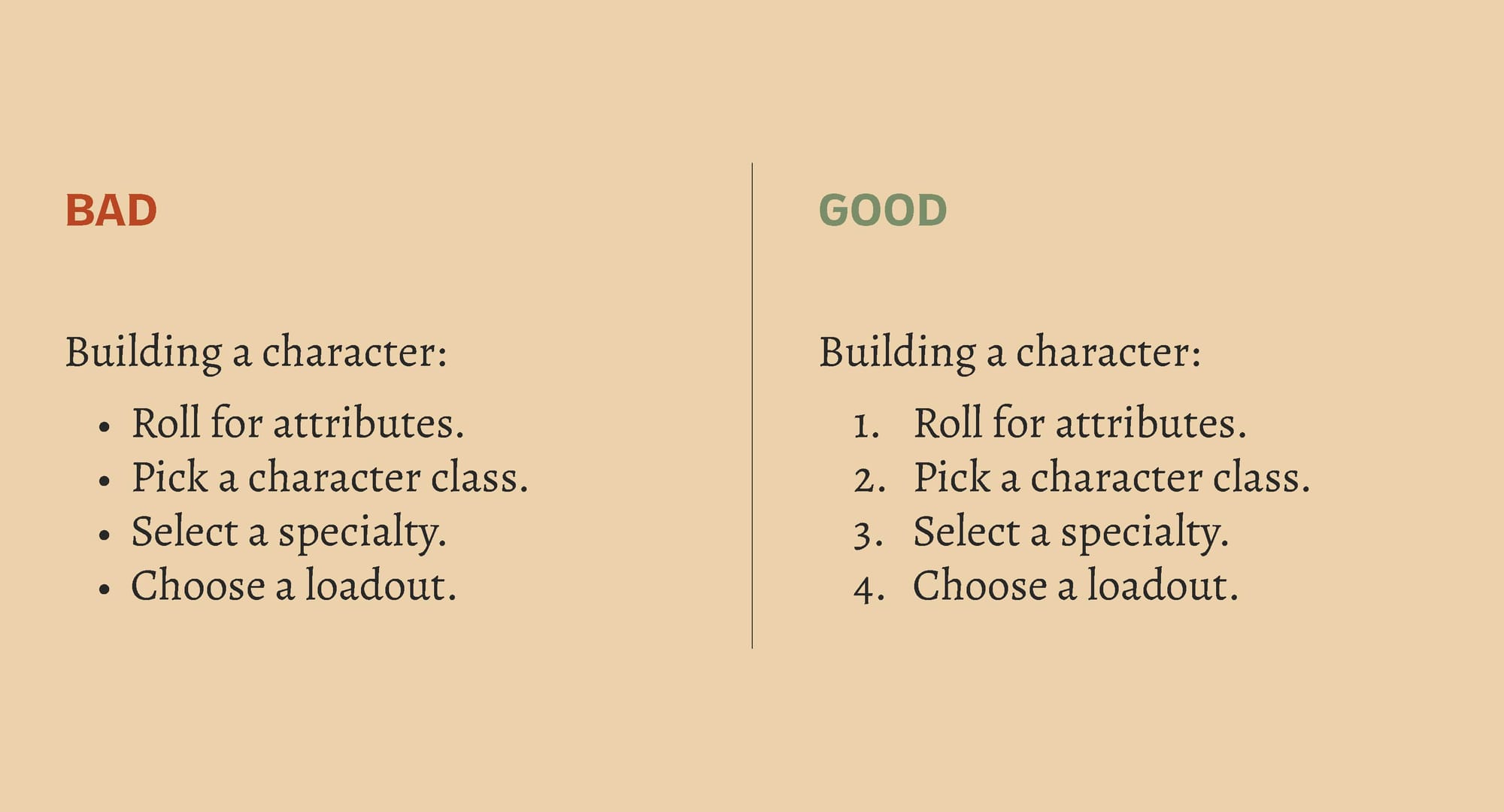
Use numbered lists when the order is procedural.
Numbered lists and bulleted lists are not interchangeable. Numbered lists are for tasks that have to be done in order, like baking a cake or creating a Pathfinder character. If the order is just for effect, then bulleted lists are fine. If the second item must come after the first item to be functional, use a numbered list.
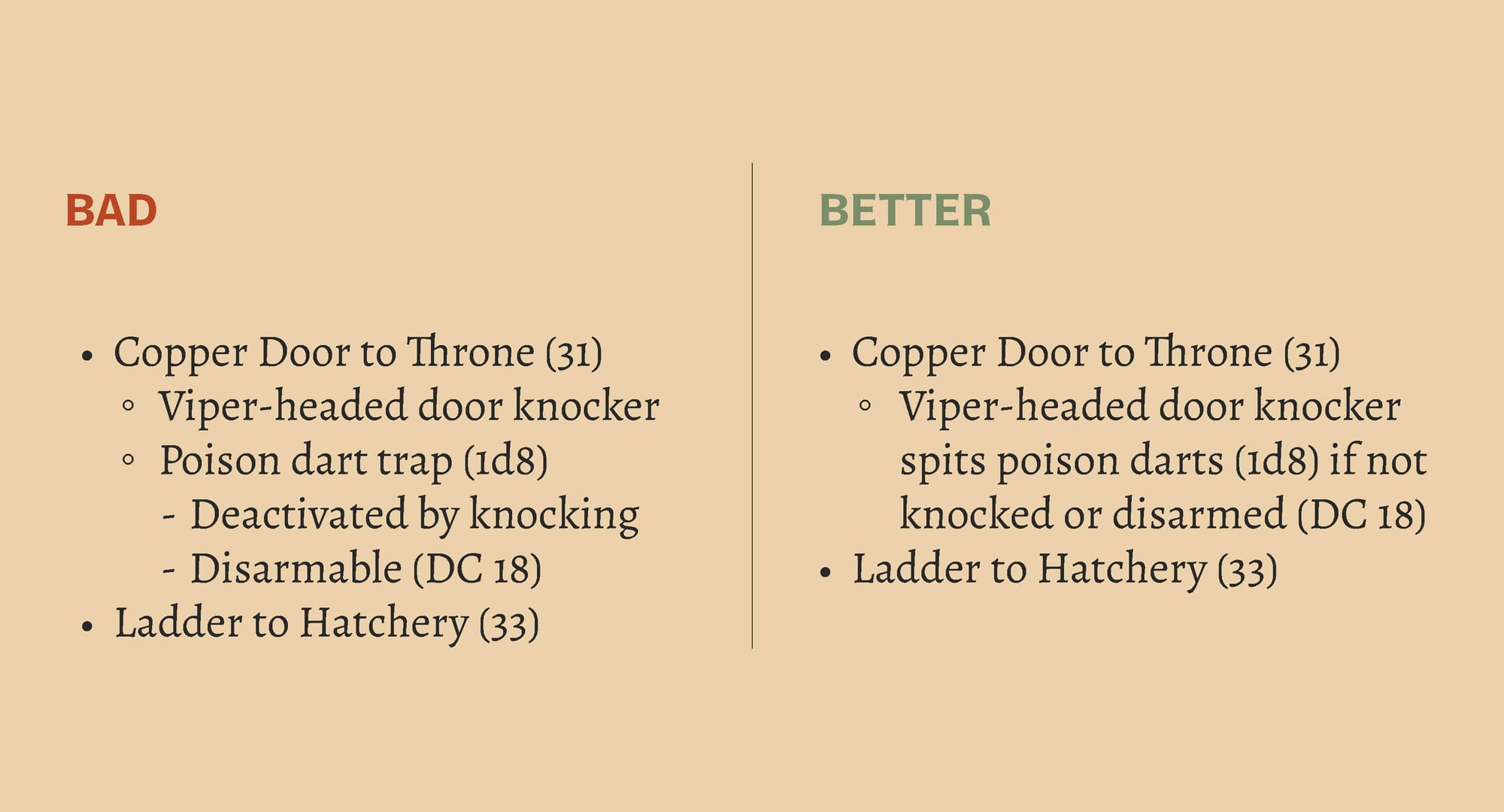
Be wary of sub-bullets and sub-sub-bullets.
Sub-bullets can nest subordinate information, but they do so at the expense of the overall list's silouette by creating a visual gap between the first-level bullets. Use sub-bullets with caution—the more you have, the more unwieldy they get over time. Most layers beyond two can be solved with re-writes and bullets of different styles.
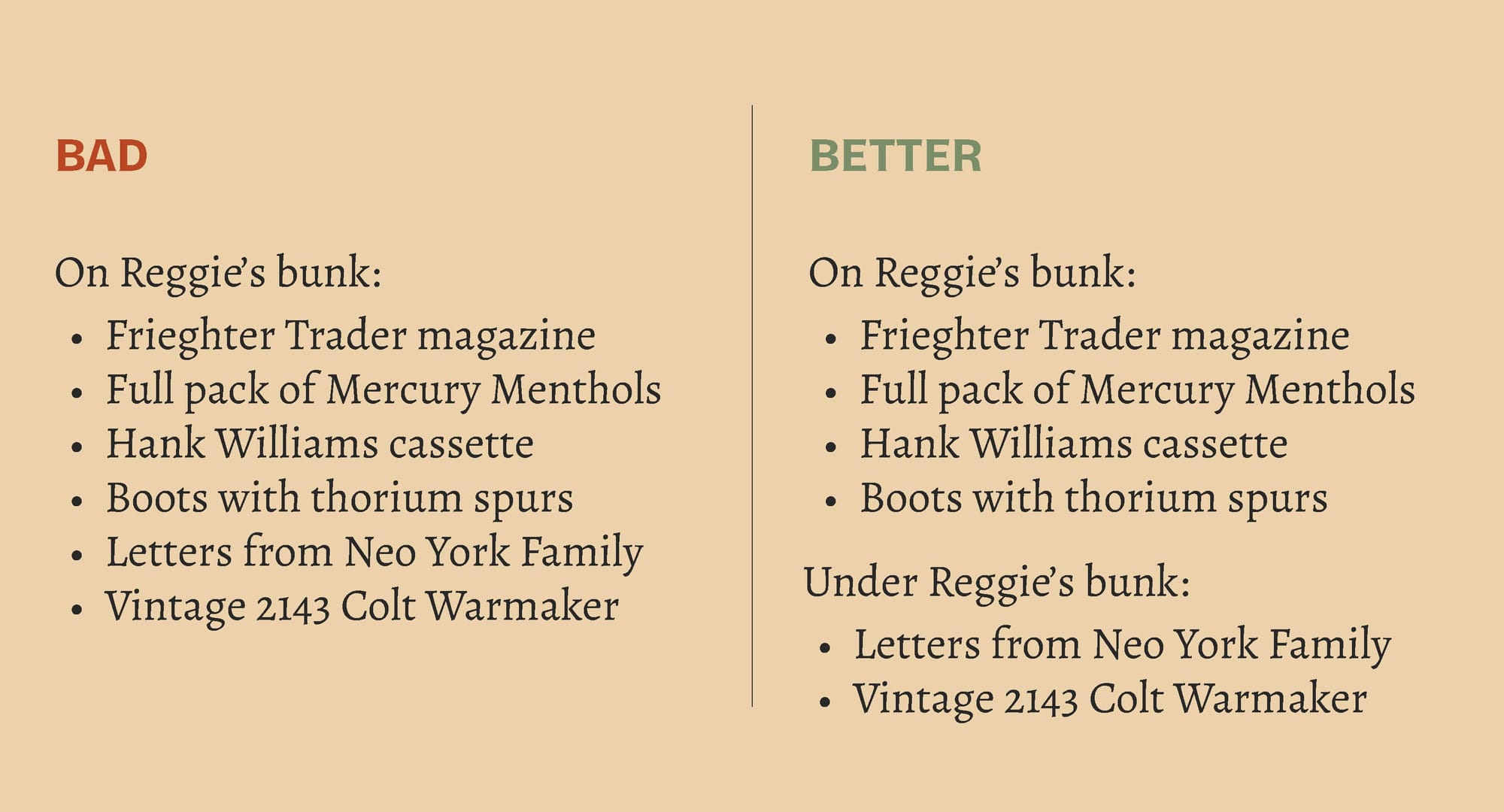
Keep lists between 3 to 5 items. 7 is (usually) the limit.
Anything fewer than 3 items can make a list feel like overkill. Anything more than 5 is likely to be overwhelming. There are exceptions. If the list is for rolling on, like one for wandering monsters, the audience can ignore most of the items. There are also ways to break up a list into categories, allowing the audience to absorb the content in a more natural or compelling way. For example, some adventures put doors and exits in a separate list. Others might place monsters or treasure in separate lists.
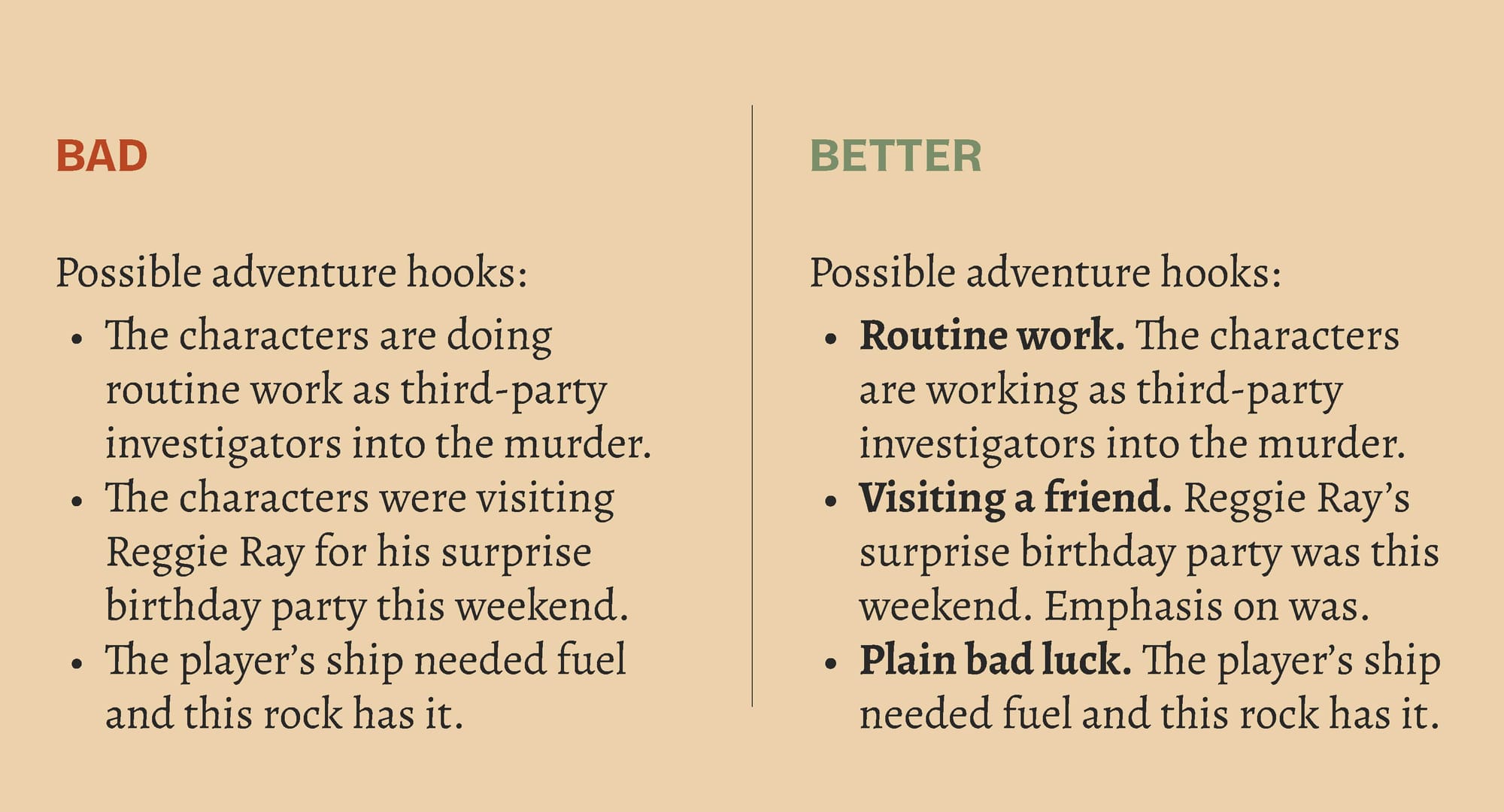
For complicated lists, consider using lead-ins.
Ideally, every bullet is simple and short enough to stand on its own. If that's not possible, consider starting each bullet with an intro sentence with a bolder formatting. Think of your list like a series of ledes that the audience can scan and decide for themselves how deep to delve.
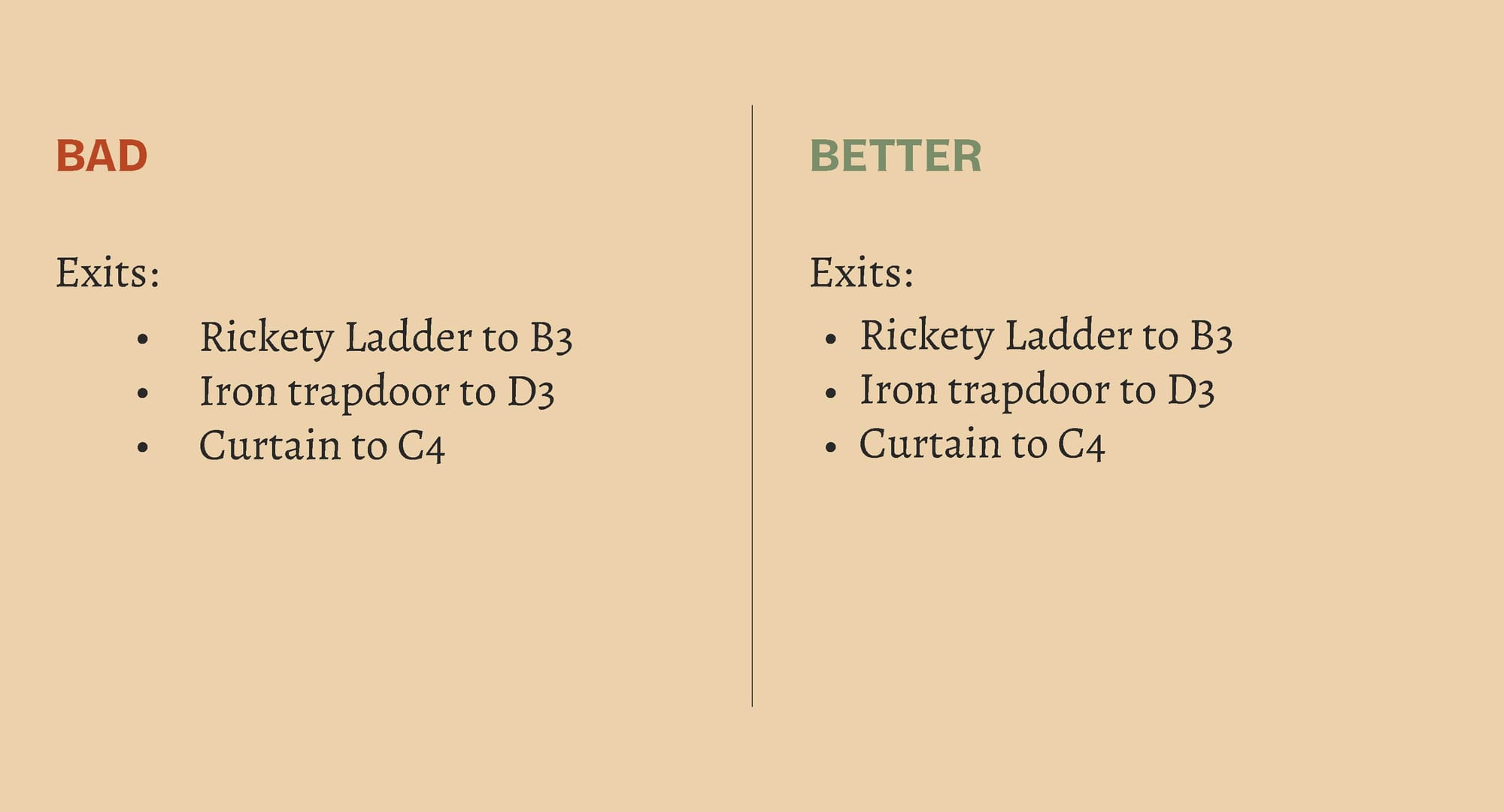
Be modest with your list indentations.
The indent length popularized by word processors is excessive. You don't need a lot of space to make lists legible, especially when your page and line length are narrower than US Letter or A4. You want to conserve that horizontal space when you can. A good starting point is one em—the point size of your body text. In addition to being more efficient, the em is proportional to your body text, columns, and page. If you're working in CSS, 1 rem is even better.
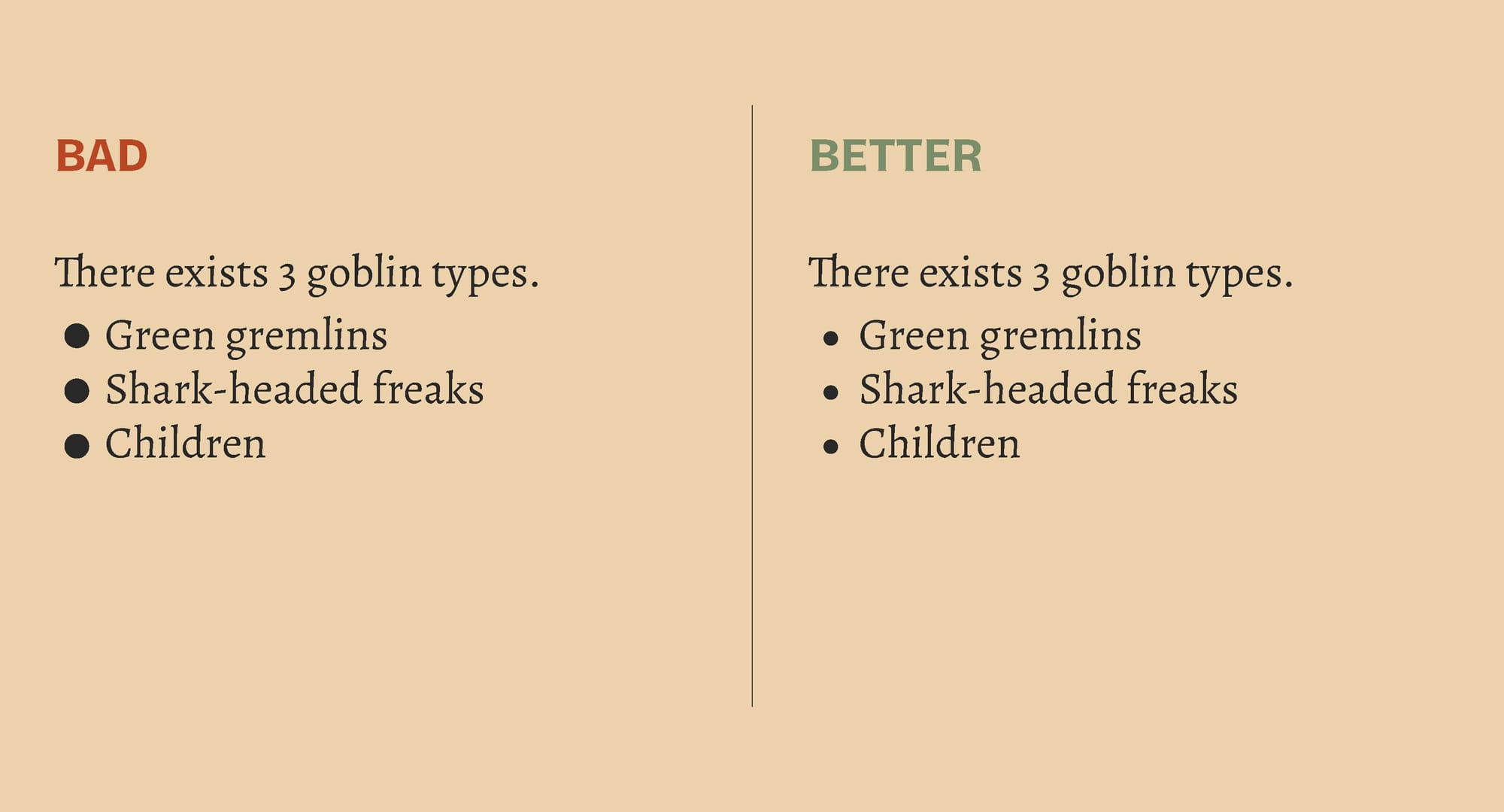
Keep the bullets small but mighty.
There's a misconception that bullet points, fleurons, and other list icons need to be "legible" in the way that words and numbers are. This leads designers to make large icons that dwarf the words—don't do this. The bullets are second fiddle to the content, so long as they're recognizable, they should be somewhere between 50% and 30% as big as the capital letter.
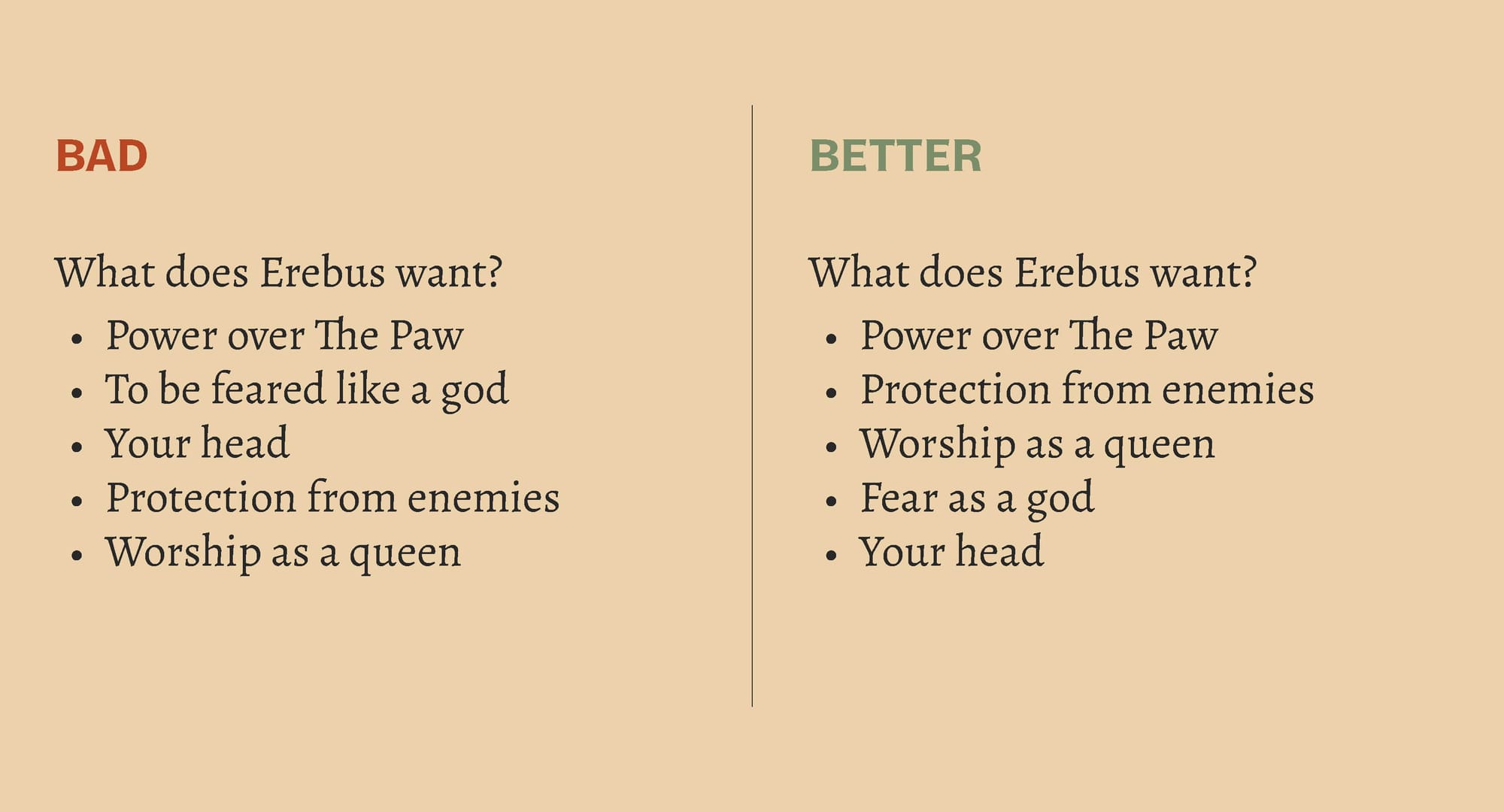
Use order and grouping for effect.
Depending on your priorities, you have two things to consider: drama and function. If you're aiming for the thematic, you want to consider the rhythm and implications of your order. A thematic design might lull the reader into a sense of calm or create juxtaposition for effect. They might end a list with a knife-wielding goblin. The functional design will group things by type for easier retrieval and put the biggest concerns—like a knife-wielding goblin—first. In the ideal execution, your list achieves both, but sometimes priorities demand different results.
Summary on designing lists
Final recommendations:
- Decide what kind of lists (if any) your project should use.
- Use numbered lists when the sequence is procedurally important.
- Write and design your lists so that the items are parallel in their format.
- Avoid cluttering your lists with overly long sentences or redundancies.
- Beware of sub-bullets. They can create more visual noise than clarity.
- Pick and choose elements that match your work's tone, look, and feel.
Additional Reading
This week's article dug deep into the bookshelf. Unfortunately for you, that means a lot of my sources aren't free. The APA Style Guide and Nielsen were particularly helpful inspiration in my initial search.
Let me know what you think of today's article. Be merciful on my examples. It's hard making fake lists. If you have any additional tips or questions, post them in the comments, and don't forget to like, share, and retweet on social.
Until next time, I'll keep exploring.

 Jeremiah Shoaf
 Clayton Notestine
Explorers Design is a production of Clayton Notestine. If you liked this article, please consider liking, sharing, and subscribing. Members who pay $5/month also get access to additional tools, templates, and inspiration.